



Hello world!
Welcome to WordPress. This is your first post. Edit or delete it, then start writing!
Manchester United News, Transfer Updates and Man United Community
 DENIS LAW’s BACK-HEELED GOAL NEVER RELEGATED MANCHESTER UNITED
 THE BLACK PEARL OF INCHICORE
 Manchester United vs Southampton
 ROY KEANE – THE ULTIMATE WARRIOR
 Ralf Rangnick’s men drop another two points at home to scrappy Southampton
 The Fonz of Old Trafford
 REMEMBERING THE BUSBY BABES
 Manchester United vs Middlesbrough
 MANCHESTER UNITED MOVE INTO FOURTH WITH A FERGIE TIME WINNER FROM MARCUS RASHFORD
 MAN UTD, GEORGE BEST, SIR ALEX & ME – MEMORIES OF A BELFAST BOY – PART 3
Welcome to WordPress. This is your first post. Edit or delete it, then start writing!
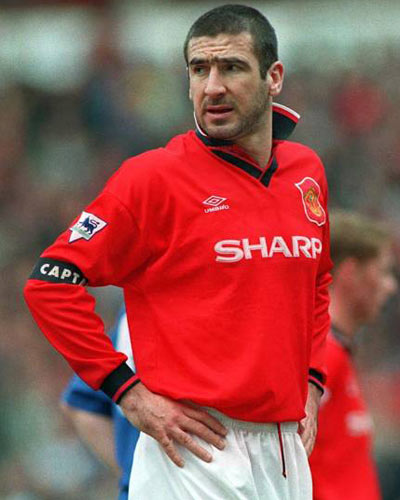
Written by John White for Manchester United Then & Now
We all have our very own special memories of Eric Cantona playing for Manchester United.
I would like to share my own with you from a game I was so privileged to be at.
A man can be an artist in anything. In food. In writing. Whatever. It depends on how good he is at it. Eric Cantona’s art was scoring goals. He was about to create his Masterpiece.
The famous Italian artist, Leonardo da Vinci, painted the Masterpiece of his life, the “Mona Lisa,” between 1503 and 1506. It was an archetypal Masterpiece of the Italian Renaissance. On 21 December 1996, Eric Cantona put his football easel to use and painted his own Masterpiece, an iconic goal. It was an archetypal Masterpiece of the Premier League. The Italian Master put his art on canvas. Cantona’s canvas was the Old Trafford pitch. Da Vinci was also an Engineer and Inventor who conceived many ideas way ahead of his time on earth (1452-1519), conceptually inventing the parachute and the helicopter. He even drew the first ever plans for a submersible vehicle. Eric, United’s French Master, was also an Inventor, creating many goals in his mind before executing his plans and scoring a goal. He sank the hearts of many defenders.
On 21 December 1996, Sunderland visited Old Trafford in the Premier League. United were the reigning Champions of England and holders of the FA Cup. Sunderland were playing in their maiden Premier League season having won Division One by four points over Derby County in season 1995-96 who were also promoted to the Premier League. Sunderland’s style of play was aggressive, but totally committed to winning which reflected the demands and style of play their manager, the former Everton midfielder, Peter Reid was known for during his successful playing career. In season 1984-85, Reid won the PFA Players’ Player of the Year Award and came fourth in the World Soccer Player of the Year Award which was won by Juventus’s talismanic French captain, Michel Platini.
It was United’s 18th Premier League game of the season in defence of their trophy, having won 7, drawn 7 and losing 3 of their previous 17 Premiership games. The three losses all occurred consecutively: 5-0 away to Newcastle United, 6-3 away to Southampton (scorers: David Beckham, David May, Paul Scholes) and a 2-1 loss at Old Trafford to Chelsea (scorer: May). United were sitting in third place in the table.
Sunderland were maintaining their own among the “Big Boys” when they faced the Double winners who had their very own talismanic French captain, Eric Cantona. In their first 17 outings they notched-up 5 wins, 5 draws and 7 losses. Six days before they made the trip to Manchester, Reid’s side beat Chelsea 3-0 at their famous Roker Park home. Sunderland nicknamed “The Black Cats,” did not move to the Stadium of Light until the 1997-98 season.
The Manchester United team which played Sunderland was:Peter Schmeichel, Gary Neville, Denis Irwin, David May, Gary Pallister, Paul Scholes, Phil Neville, Ryan Giggs, Nicky Butt, Eric Cantona (Capt), Ole Gunnar Solskjaer Subs: Brian McClair (for Pallister, 46 mins), Karel Poborsky (for Solskjaer, 54 mins), Ben Thornley (for Giggs, 63 mins)
United’s “Baby Faced Assassin,” Solskjaer opened the scoring in the 36th minute. Two minutes before half-time Cantona scored from the penalty spot against his former Nimes teammate, Lionel Pérez, who was in goal for the visitors. Solskjaer made it 3-0 three minutes into the second half. The Black Cats were getting a mauling and it was United who were doing the purring. The visitors’ midfield was run ragged by a rampaging United who looked like they would score every time they attacked a beleaguered defence. Alex Ferguson’s side were producing the style of play which saw them win the Double the previous season. And in Eric Cantona, they possessed a player who knew what it took to win a game, and win it in style. Butt was rewarded for his endeavours in the United midfield when he scored to make it 4-0 in the 58th minute. There was still 30 minutes to go but the game was effectively over. There was no need for any United player to exert themselves any further and they would be forgiven if they took their foot off the pedal knowing they had another game in five days, Nottingham Forest at the City Ground. But Cantona wasn’t finished with Sunderland, he had them on his own ball of string and he was going to tease them further.
With 21 minutes of play remaining, Cantona collected a pass on the halfway line with his back to the Sunderland goal. Using his strength and sublime skill, he spun around Kevin Ball and Richard Ord and passed the ball to McClair who was making his way into the Sunderland half. Ord kicked thin air when he attempted to tackle Cantona. Ball and Ord had hopelessly failed to pin Eric down throughout the game, both players fully aware that he was the one player who made United tick. But they could get nowhere near him. “Twister,” a movie about extremely violent tornadoes was released in 1996 and trying to pin Cantona down was like trying to stop a tornado from wreaking havoc in its’ path. Cantona could be equally as destructive. McClair and Cantona did a quick one-two, McClair’s lay back feeding Cantona who was just inside the penalty box. Cantona composed himself, looked at where Pérez was standing and cooly chipped the ball over his fellow Frenchman and into the net off the inside of the left hand post. It was the deftest of touches, a dink which was executed to perfection, a work of art. But Eric had one final stroke of the paintbrush left before his Masterpiece was complete. Still standing on the same spot, collar turned up, hands by his side, Cantona slowly rotated 360 degrees to accept the adulation scoring such a spectacular goal deserves. There was no expression on his face as he raised his arms in the air. McClair hugged him as if to say: “Thank you Eric for allowing me to be part of such a beautiful goal.” The United fans were delirious with delight, they had just witnessed a very special goal from a uniquely special player. But Cantona just looked around him as if to say to the fans: “I am Cantona. What else did you expect me to do?”
It would have been so appropriate if the stadium announcer had played Carly Simon’s song “Nobody Does It Better,” in recognition of Cantona’s extraordinary, but perfectly executed, chip which he celebrated inauspiciously, but with so much impudence.
“Nobody does it better, Makes me feel sad for the rest, Nobody does it half as good as you, Baby, you’re the best, And nobody does it better, Though sometimes I wish someone could, Nobody does it quite the way you do, Why’d you have to be so good?”
Cantona’s celebration after scoring such an iconic goal was voted the Premier League’s greatest ever celebration. Cantona was aged 30 at the time. Pérez was wearing No.30 on his back. United won the game 5-0 with Eric giving the United fans an early Christmas present.
In 1935, the second edition of the world famous golf tournament, the US Masters (in 1934 it was known as the Augusta National Invitational Tournament), was held at the Augusta National Golf Club, Augusta, Virginia, USA, a moment occurred in the fourth round of the tournament, which became Golf’s fourth Major, which went down in the annals of sporting history. The American golfer, Gene Sarazen, who snubbed the inaugural tournament the year before when it was known as the US Invitational, trailed leader Craig Wood by three shots after 14 holes of play. At the fifteenth hole, a Par 5 covering a distance of 530 yards and named “Firethron,” Sarazen found himself 235 yards from the flag. He took out the 4 wood from his golf bag and fired his shot at the hole. Sarazen’s shot was hit lower than Cantona’s measured chip, it never rose higher than 30 feet off the ground, and it carried the water hazard and skipped its way towards the hole, and then dropped inside it.
Watching the game, O.B. Keeler, an actor and a writer, described Sarazen’s shot: “The ball bounded once, twice and settled to a smooth roll, while the ripple of sound from the big gallery went sweeping into a crescendo, and then the tornado broke.” However, Grantland Rice, a founder member of Augusta National, then famously summed it up best of all by calling it: “The Shot Heard Around The World.” Perhaps Rice was alluding to the celebrated sportswriter Keeler wrote: “The ball bounded once, twice, and settled to a smooth roll, while the ripple of sound from the big gallery went sweeping into a crescendo. And then the tornado broke.” Lovely words but it was the foremost voice of his generation, and a founding member of Augusta National to boot, Grantland Rice, who summed it up best, a clever use of words to allude to the start of the American War of Independence in 1775 and which lasted until 1783. Sarazen’s albatross shot, a double eagle in golfing terms, could not quite match Cantona’s chip towards the Sunderland goal but it did ensure that he pulled on the famous Green Jacket to identify him as a US Masters Champion.
Eric Cantona’s beautifully lobbed dink over Pérez to score may not have reached the ears or eyes of the world as Sarazen’s shot some 70 years before did, but it reeked havoc in the Premier League. Cantona’s goal sent vibrations throughout the other teams who must have been thinking just how can you stop Cantona and the Genius that he is. “Why does the eye see a thing more clearly in dreams than with the imagination being awake?” Leonardo da Vinci
Many years after the game Pérez recalled the albatross moment his side went 3-0 behind during an interview with SunSport. Pérez who was at Nimes with Cantona in 1991, said: “This goal (Cantona’s lob) shouldn’t exist. We were losing 3-0 after 48 minutes and Eric had stopped playing. He stayed in the middle of the pitch and didn’t run any more because the game was over. Then there was one moment, when Ryan Giggs crossed and he had a shot which I saved. It was the only save I think I made in the game. Eric then said to me, just in a funny way, ‘Lionel, you should have left it!’ But I didn’t want to be smiling with him when we were losing. Before the match, one of my friends rang me from France to say he’d seen Eric playing against Chelsea and Frank Leboeuf was very friendly with him on the pitch. I thought, ‘I’m not going to be kind with him because I don’t want any French cameras seeing that. I don’t want to be that man laughing when we are losing 3-0’. So I just blanked him when he was joking with me. And after I blanked him he started to run everywhere because he wanted to f* me! He started to be mental. He was like, ‘F**** hell, he doesn’t want to give me an answer. If this guy doesn’t want to talk to me, he’s going to see what I am made of.’ I am very sure that if I answered him, he would have stayed calm until the end of the game. But, instead, his attitude really changed.”
During a UTD Podcast Cantona was asked about his floated goal over a dumbfounded Pérez. The United Legend said that his goal was an act of revenge and explained why. “I never celebrate a goal in the same way, because every goal is different. The energy is different, everything is different. But maybe I did this celebration, I don’t know, it’s nice to take the energy of all the fans, you know? And sometimes it’s even more. Maybe it’s because the goalkeeper, he was French. Before the game, in the tunnel, I came to him to shake his hand and say hello to him because I hadn’t seen him since I left (Nimes). It was the last club I played for in France. And he didn’t want to shake my hand. So maybe I scored this goal because of that! That’s the biggest humiliation for a goalkeeper, and this kind of celebration too. Because he’s angry and you don’t run anywhere. I just stand there. Look at me.”
Pérez added: “Even now, every time Eric is on the TV in France, I have phone calls from friends because they show the goal all the time. I’m on TV a lot, but it’s not because of me unfortunately! I smile because I always remember all my family were over to see me for Christmas and came to watch the game. My Grandma was there and after the game she said, ‘Have you seen all these French flags? They are for you.’ It was funny because she didn’t realise they were not for me, but for Eric!“
Leonardo da Vinci was also renowned in the fields of chemistry, geometry and mathematics. Cantona’s goal against Pérez had the chemistry of his one-two touch move with McClair, the geometry of Cantona knowing the properties of the space around him and a perfectly calculated chip towards goal that even the eminent mathematician, Albert Einstein, would have been proud of.
Leonardo da Vinci once famously said: “Marriage is like putting your hand into a bag of snakes in the hope of pulling out an eel.” Eric Cantona said: “I am in love with Manchester United. It is like finding the perfect wife.” Cantona was as slippery as an eel and had an electric shock to go with it.
The Mona Lisa hangs proudly in Le Louvre Museum, Paris, France. The painting’s novel qualities include the subject’s expression, which is frequently described as enigmatic, the monumentality of the composition, the subtle modelling of forms, and the atmospheric illusionism. The enigmatic Eric Cantona was born in France and an image capturing his iconic goal against Sunderland hangs proudly in the hallowed corridors of Old Trafford.
Did You Know That?
During the COVID-19 pandemic no football was played and so BBC TV’s Match of the Day programme on a Saturday night decided to get Gary Lineker, Alan Shearer and Ian Wright together via a three way teleconference from their own homes to talk about football. A number of shows were produced along with a “Top 10” style theme to them. One such show was “Top Ten European Imports.” Each player selected their Top 10.Shearer’s Top 3 were: 1. Roy Keane, 2. Thierry Henry, 3. Eric Cantona (Cristiano Ronaldo was No.7)Wright’s Top 3 were: 1. Roy Keane, 2. Thierry Henry, 3. Cristiano Ronaldo (Eric Cantona was No.4)
During the discussion about Eric Cantona, the following was said:Ian Wright: “For me. He was the ultimate talisman in a football team.”Shearer: “If you are going to play with your collar up you’ll have to be some player. And he was.”Lineker: “He’s quite the individual though wasn’t he? Quite a personality. On the field and off it.”
Wright had nothing but admiration for Cantona and he recalled the goal against Pérez fondly: “It’s so majestic. He could have been a Gladiator in Roman Times. That’s how he celebrated. He had such an aura about him.” Wright then recalled how his Arsenal teammate, Marc Overmars, failed so badly in attempting to copy Cantona after the Dutch winger scored the only goal of the game at Old Trafford on 14 March 1998. Arsenal’s 1-0 win effectively sealed the 1997-98 Premier League title for The Gunners. Wright held his hands up in the air and said: “Did you see when Marc Overmars tried it? It was ridiculous. It was like watching an Oompa Loompa doing something.” Shearer burst into laughter.
Wright then turned his attention to Cantona’s celebration after scoring and said: “You know something? I still feel that the Cantona celebration is the best because only he could do that celebration. He is the only one who could exude that kind of arrogance and confidence (Shearer could be heard agreeing). It was beautiful to watch. It was a beautiful thing to watch. They should do it in slow motion so people could ………….Do it in slow motion so people can watch it in slow motion. Just watch the magna ……. the majesticness of him.”
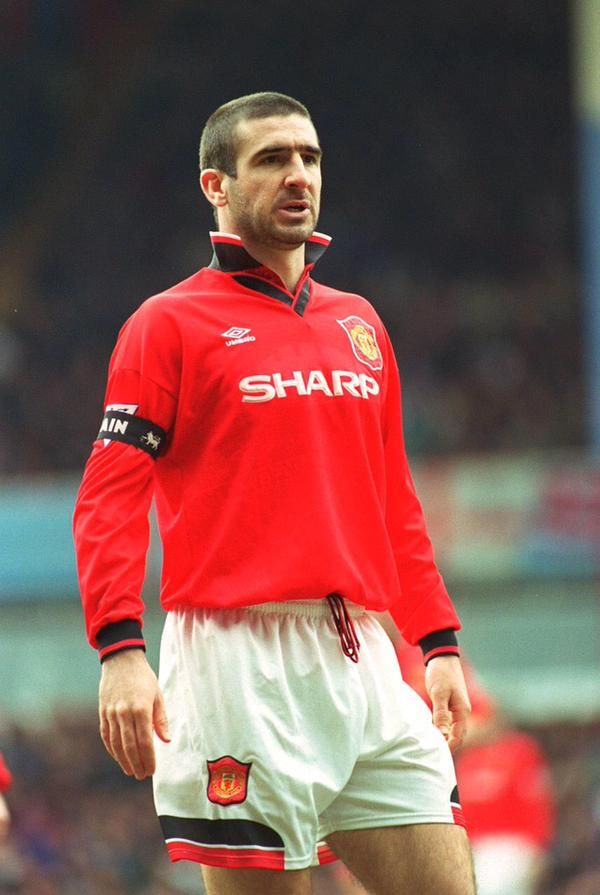
Written by John White for Manchester United Did You Know That
Twenty-six years ago today, Eric Cantona returned to play for Manchester United against Liverpool in the Premier League at Old Trafford following his 9 month ban. Eric was banned from playing after he kung-fu kicked a Crystal Palace fan who was verbally abusing him as he walked towards the changing rooms after being sent off during United’s 2-2 draw with Crystal Palace on 25 January 1995 in a Premier League game at Selhurst Park.
“The Emperor’s New Clothes,” (Danish: “Kejserens nye klæder”) is a short tale written by Hans Christian Andersen, the famous Danish author and was published in 1837. Anderson’s story is about two weavers who promise to make an Emperor a new suit of clothes that they claimed was invisible to those who were unfit for their positions, stupid or incompetent. But, in reality, the two weavers tricked the Emperor and did not make him any clothes at all, convincing the Emperor that his new clothes were not only invisible to him but invisible to everyone. When the Emperor paraded his “new clothes” before his subjects none of them dared to say that they could not see any clothes on him for fear that they would be regarded as being stupid. However, a child in the crowd cried out: “But he isn’t wearing anything at all!” The weavers had been found out. The tale has been translated into over 100 languages.
One hundred and sixty years later, the Emperor of Manchester United, Eric Cantona, changed his three Manchester United No.7 jerseys for a costume designer’s wardrobe as he took the decision to retire from football and concentrate on his acting career. Eric’s shock decision came just 24 hours after he celebrated United’s fourth Premier League title win in the past five seasons with his teammates on the pitch at Old Trafford after they beat West Ham United 2-0 in the final game of the season on 11 May 1997 (scorers: Ole Gunnar Solskjaer & Jordi Cruyff). Cantona signed for Manchester United on 26 November 1992, a £1.2 million bargain deal from Leeds United, and in his five seasons at the club he, to continue with the fairy tale theme, awoke a Sleeping Beauty from their 26 year slumber and played an instrumental part in helping United win the inaugural Premier League Championship title in season 1992-93. On countless occasions, Eric made defenders look unfit for their positions, stupid or incompetent.
“Everyone’s allowed to be in love with the wrong person at some point. In fact, it’s a mistake not to be.” (Harriet Evans)
Eric Cantona’s boyhood dream came true when he was 21–years old after his hometown club, Olympique Marseilles, signed him from Auxerre (82 League games, 23 goals), where he began his professional career in 1983. For the young Cantona it should have been the perfect marriage, a marriage made in heaven. He felt at home in his Stade Velodrome surroundings in Provence-Alpes-Côte d’Azur. But the marriage did not work out and Eric was sent out on loan to Bordeaux (1989, 11 League games, 6 goals) and Montpellier (1989-90, 33 League games, 10 goals). He felt unloved at his boyhood club and in 1991 moved to Nimes where he fell in love with the game again, scoring twice in 16 League appearances. Eric won the first of his 45 international caps (20 goals) for Les Bleus in August 1987 and would have won so many more had it not been for the fact that in September 1988, he lost his head, and not for the first time. He was furious after being dropped from the national team by the man who gave him his debut for his country, Henri Michel. Cantona called Michel a “bag of shit” in a post-match TV interview and was indefinitely banned from all international matches by the French Football Federation. The international ban was the final straw for Eric in his homeland and he decided it was time to pursue the next stage of his career in another country.
Despite a very keen interest from Trevor Francis, the Sheffield Wednesday manager (1991-95) in January 1992, Eric did sign for an English club, and one like the South Yorkshire based Sheffield Wednesday, nicknamed “The Owls,” Leeds United. Because of the inclement weather Eric could not play in a “trial” match for Sheffield Wednesday. Cantona’s arrival in England sparked a media circus, the “Bad Boy” of French football had landed on English shores. But contrary to what was reported at the time (January 1992), Cantona gave his version of events in an interview to our Four Two magazine in April 2020: “He (Trevor Francis) did not invite me for a trial with Sheffield Wednesday. I was there for a week and I thought I was there to sign for them. My lawyer was there and he spoke to try and find a way to agree a contract. I trained and played in a friendly game (indoors). We won 4-3 and I scored three goals. After one week, Trevor Francis asked me to spend one more week on trial. There weren’t a lot of foreigners in England then, maybe some from the north of Europe but not many from the south. Maybe they were suspicious, but I was a France international and Sheffield Wednesday wanted more time to decide about me. That was not a very good way to go about things.”
Cantona signed for Leeds United and helped them become the Champions of England in 1991-92, the last ever English First Division Football Championship while United were runners-up and Sheffield Wednesday finished third.
There is a very old saying: “As wise as an Owl.” But Trevor Francis’s decision not to sign Cantona certainly did not make him one of his club’s wisest Owls. Francis was heavily criticised for allowing Cantona to slip through his fingers but as Francis pointed out in his autobiography, “One in a Million,” it wasn’t a case of Sheffield Wednesday allowing Cantona to opt for Leeds United instead of The Owls. “In 1992, whilst we were still finding our feet in the top Division, I got a call from Dennis Roach, the agent who had taken me from Manchester City to Sampdoria. He wanted me to do him a favour on behalf of Michel Platini who was the French team manager at the time. Dennis was asking me whether I would allow Eric Cantona, who was coming out of retirement, to train with us for a few days. Before agreeing I told Dennis that I didn’t mind helping as long as it did not cost the club any money – air fares, hotels, other travel – everything had to be paid for by his party. It was all agreed and Eric arrived for two days’ training. Unfortunately it was in a period when it was very wintry in Sheffield, such that we could not get on the training field. On the first day of Eric’s stay we had to use an AstroTurf pitch in Rotherham and on the second we played an indoor game against an American team. Cantona played quite well in that game and there was a lobby from the media about Wednesday signing him. There was never, ever any suggestion of us signing Eric Cantona. He was there purely as a favour for Dennis Roach and Platini. I had made that clear right from the start,” said Francis.
Eric took the decision to retire in December 1991 after he threw the ball at the referee whilst playing for Nimes. Eric did not like a decision the referee made. Cantona was then ordered to appear before a disciplinary hearing by the French Football Federation and was given a ban for one month. Eric wasn’t going to leave the room without having his say and he approached each member of the Disciplinary Committee and one by one he called them an “idiot.” The Disciplinary Committee increased his ban to two months resulting in Eric announcing his retirement from football on 16 December 1991.
But Eric soon fell out of love with Leeds United and on 26 November 1992, Alex Ferguson scooped one of the best transfer deals he had ever made and acquired Cantona from the Yorkshire club for £1.2 million.
When he hung up his boots Eric was just two weeks away from celebrating his 31st birthday (born in Marseilles on 24 May 1966) and most definitely could have played on for at least two or three more seasons at the same level as before as he was a player who was one of the first to realise that his lifestyle and diet played an important part in the longevity of a player’s career. The Arsenal manager at the time, Arsene Wenger, a fellow Frenchman, introduced a strict dietary regime among his players not long after his appointment as the boss of the London club on 1 October 1996. The pair were football visionaries, Eric on the pitch, Wenger in the dugout. In his five seasons as the “Emperor of Old Trafford,” United won their first top flight League Championship since Bobby Charlton, Denis Law and George Best made United Champions of England in season 1966-67, the 1992-93 Premier League. In season 1993-94, United won the Double of Premier League and FA Cup followed by a second Double in 1995-96 and the Premier League crown in 1996-97. There is absolutely no argument, no doubt, no question that United would have also lifted the Double in season 1994-95 had King Eric not been given a 9 month ban from the game in January 1995. But to quote the idiom: “There is no use crying over spilled milk.”
In an interview with FourFourTwo magazine Cantona was asked about his “Kung-Fu” attack after being sent off in an away game versus Crystal Palace on 25 January 1995, and said with regret: “I did not punch him strong enough. I should have punched him harder. I didn’t watch it after on television. Because I knew. All I had was journalists around my house. That’s all I could see. My house was small. They blocked the light.”
“Four hostile newspapers are more to be feared than a thousand bayonets.” (Napoleon Bonaparte, Emperor of France, 18 May 1804–6 April 1814 & 20 March 1815–22 June 1815)
The British press absolutely vilified Cantona after the incident as if we was some kind of new age professional football thug who attacked an innocent fan watching a game of football. Eric reacted to what can only be described as disgusting and unpalatable remarks by a so called Crystal Palace fan about Eric’s mother. Eric was wrong in what he did, he knew that, but his volatile nature that night erupted like a volcano exploding, sending burning ash into the atmosphere. After the Football Association handed down their sentence, Eric, quite rightly thought: “To hell with it. I am fed up with football. J’abandonne (I quit).” And, only or the fact that his manager, Alex Ferguson, got on the first plane to Paris, France where his mercurial French star had retreated to after the ban, a punishment Eric considered to be more than harsh, and persuaded Eric to see the ban through, Cantona may have hung his boots up two years before he actually did. His manager persuaded him to serve the ban and come back to Old Trafford, a better, more dedicated, driven, passionate and winning player.
“History is the version of past events that people have decided to agree upon.” (Napoleon Bonaparte)
When Eric Cantona served his ban and once again pulled on the No.7 jersey of Manchester United versus Liverpool on 1 October 1995, he set about creating more history for Manchester United. Making a comeback after such a setback could prove to be insurmountable for most men, but as Eric famously said in the 2009 movie “Looking For Eric,” “I am not a man. I am Cantona.” And, in season 1995-96, Eric did indeed help United rewrite the English football history books when United won a second Double, with Eric scoring many crucial goals along the way. He scored in five 1-0 victories after the turn of the year and the only goal of the game in the 1996 FA Cup final victory over Liverpool. One of the favourite songs of United fans during the 1990s was D:Ream’s “Things Can Only Get Better.” In season 1996-97, Alex Ferguson wanted more from his players. Despite having already won 3 League titles, 3 FA Cups, a League Cup, the European Cup Winners’ Cup and the UEFA Super Cup, Ferguson knew that in order for him to be considered one of United’s greatest ever managers, he had to step out of Sir Matt Busby’s shadow and bring the Champions League (European Cup) to Old Trafford. Then, he would be held in the same aura as Busby. He would be immortal.
The summer of 1996 saw some comings and goings at Old Trafford. Steve Bruce left on a free transfer and joined Birmingham City, Lee Sharpe joined Leeds United in a £4.5 million transfer, back-up goalkeeper Tony Coton moved to Sunderland for £600,000 and Paul Parker was given a free transfer to Derby County. Four new players arrived: centre half Ronny Johnsen from Besiktas for £1.2 million, the Czech Republic winger Karel Poborsky who had been one of the stars at the 1996 European Championships hosted by England was signed from Slavia Prague for £3.5 million, Jordi Cruyff, the son of the legendary Johann Cruyff, arrived from FC Barcelona for £1.4 million and an unknown striker who cost United £1.5 million. The striker was none other than Ole Gunnar Solskjaer who left FK Molde in Norway to start a career at Old Trafford which would make him a Legend.
“The truth about the life of a man is not what he does, but the legend which he creates around himself.” (Oscar Wilde)
In season 1996-97, Eric Cantona left Old Trafford a Legend.
United’s defence of the Premier League tie began with a tricky opening day visit to Wimbledon. The Dons were homeless at the time having vacated their old Plough Lane ground in 1991 and rented the home of Crystal Palace, Selhurst Park, until they could find a new home. United won the game 3-0 and it seemed quite fitting that the player who secured them their second Double three months earlier scored the first goal of the new campaign, Cantona. Denis Irwin added a second before David Beckham unleashed a shot from just inside his own half which sailed over the head of a hugely embarrassed Neil Sullivan. As Eric would say it was “Magnifique.” United then drew their next three games before Cantona paid a trip to his old stomping ground, Elland Road, on 7 September 1996. The Leeds United fans berated Cantona throughout the game but he ignored the incessant booing, turned is collar up and got down to what he did best, orchestrating his midfield and directing play in his wing section. Cantona, the United captain, led his teammates to a comfortable 4-0 victory with an own goal by goalkeeper Nigel Martyn and goals from Nicky Butt, Karel Poborsky (his first for United) and in the 90th minute Eric issued the Coup d’Etat. Eric, not for the first time in his career, had silenced his critics. A week later United went to the top of the table after defeating Nottingham Forest 4-1 at Old Trafford with Eric converting two penalties in is usual confident manner from the spot and goals from Ryan Giggs and Solskjaer. But United then had a horrendous late October and too many their hopes of retaining their mantle as Champions of England had gone after two bruising defeats. Newcastle United exacted the perfect revenge after being totally outclassed by United in the curtain raiser to the season, the 1996 Community Shield when they were beaten 4-0 (scorers: Cantona, Butt, David Beckham & Roy Keane) at Wembley Stadium, London. The Geordies were superb at St James’ Park and thrashed United 5-0. Then six days later, 26 October 1996, United went down 6-3 to Southampton at The Dell (scorers: Beckham, David May, Paul Scholes). When United lost 2-1 to Chelsea at Old Trafford on 2 November 1996 (scorer: May), they had slipped from top spot to 6th in the table. The bookmakers were offering attractive odds on United ending their slump and rallying back to win the title, a bet not many punters took-up. On 26 November 1996, Leicester City put United out of the League up in Round 4, winning 2-0 at Filbert Street, Leicester. The Foxes made it all the way to Wembley Stadium for the 1997 League Cup final where they drew 1-1 with Middlesbrough after extra-time and then won the replay 1-0 after extra-time at Hillsborough Stadium, Sheffield.
United then went on one of the trademark unbeaten runs, a stretch of 16 in the Premier League, which catapulted them back up to the top of the table. Cantona scored four times during the run which Sunderland ended on 8 March 1997 winning 2-1 (scorer: Andy Melville own goal), United’s last ever visit to Roker Park as Sunderland moved into their new home, The Stadium of Light, in July 1997. Solskjaer was in a rich vein of form and scored eight times but Eric was a goal maker as well as a goal scorer. The top spot had been reclaimed after beating Southampton 2-1 at Old Trafford on 1 February 1997 with goals from Gary Pallister and Cantona. United stayed top until the end of the season but their dreams of winning back-to-back Doubles and winning a first ever Treble were over on 4 February 1997 when they lost 1-0 to Wimbledon at Selhurst Park in an FA Cup Fourth Round replay. Borussia Dortmund beat United 1-0 home and away in the UEFA Champions League semi-finals and went on to defeat Juventus 3-1 in the final at the Olympiastadion, Munich, Germany.
United already had the Premier League title wrapped-up long before West Ham United arrived at Old Trafford on 11 May 1997 for the final League game of the season and United’s fourth coronation as Premier League Champions. The Hammers were safe, they finished 14th, whilst Sunderland, Middlesbrough and Nottingham Forest all dropped into the First Division. It was a dull game, both sides looked weary and were already thinking about where they would go on holiday. United won 2-0 with goals from Cruyff and Solskjaer who finished as the club’s top goal scorer in the season scoring one goal less, 19, than the No.20 he wore on his back.
Manchester United: Peter Schmeichel, Gary Neville, Denis Irwin, David May, Ronny Johnsen, Karel Poborsky, David Beckham, Nicky Butt, Paul Scholes, Ole Gunnar Solskjaer, Eric Cantona (Capt)
Substitutes: Michael Clegg for Irwin 46 mins, Jordi Cruyff for Scholes 49 mis, Brian McClair for oborsky 71 mins
Three lines from the song “Pinball Wizard,” by The Who summed Ole up:
“How do you think he does it?
I don’t know.
What makes him so good?”
When Eric Cantona was presented with the glittering Premier League trophy, no one in the Theatre of Dreams that day knew that they had just watched The King abdicate his throne. Cantona who once said: “I am in love with Manchester United. It is like finding the perfect wife,” was about to file for divorce.
Manchester United fans had the honour of watching The King play 185 times, scoring 82 goals, many of them sublime Masterpieces. Eric’s appearance record for United was: 143 Premier League games, 64 goals; 17 FA Cup games, 10 goals (including 3 in finals); 6 League Cup games, 1 goal; 3 Charity Shields scoring twice; 16 Champions League games, 5 goals.
As for Individual honours, Eric was named the Professional Footballers’ Association Players’ Player of the Year in 1993-94, the Football Writers’ Association Footballer of the Year in 1995-96 and the winner of the Onze d’Or in 1996, an award presented by the French magazine Onze Mondial, to the player voted the best in Europe. In 1993 he became the first United player since 1971 to be named in the Top 3 for the prestigious Ballon d’Or which was won that year by Roberto Baggio of Juventus with Inter Milan’s Dennis Bergkamp second. In 1971, the Belfast Boy also finished in third place in the voting behind runner-up Sandro Mazzola of Inter Milan and the winner, the world’s best footballer at the time, Johann Cruyff of Ajax Amsterdam.
Michel Platini was 30 years old when he collected his third consecutive Ballon d’Or award in 1985, the same age as Eric when he fell out of love with football.
Did You Know That?
In early 2020, Eric Cantona played the role of a King in the official music video for Liam Gallagher’s song “Once.” The video, which was filmed at Gunnersbury Park in west London, depicts Gallagher, a Manchester City fan, as a bowing butler/chauffeur serving King Eric with a glass of red wine. King Eric mimes along to Gallagher’s voice as he majestically sweeps through the grounds wearing a red cloak and a gold crown before getting into a Rolls Royce and driven away by Gallagher. Some of the lines in the song contain the lyrics “But oh, I remember how you used to shine, back then” and “You only get to do it once.” Eric was crowned a Premier League Champions four times.

Written by John White for Manchester United Did You Know That
“The road is long
There are mountains in our way
But we climb a step every day”
The first three lines from the song “Up Where We Belong” sung by Joe Cocker and
Jennifer Warnes.
In season 1974-75, United found themselves in the English Second Division after
being relegated at the end of the previous season. They had not played in the second
tier of English football since season 1937-38 when they finished runners-up to Aston
Villa and won promotion back into the top flight where they had remained until the
ignominy of relegation in season 1973-74.
Gone were away trips to Anfield (Liverpool), Arsenal Stadium (Arsenal), Elland Road
(Leeds United), Goodison Park (Everton), Maine Road (Manchester City), St James’
Park (Newcastle United), Stamford Bridge (Chelsea) and White Hart Lane
(Tottenham Hotspur). These were replaced with road trips to play Blackpool at
Bloomfield Road, Bristol Rovers at Eastville Stadium, Hull City at Boothferry Park,
Leyton Orient at Brisbane Road, Millwall at The Den, Notts County at Meadow Lane,
Oxford United at Manor Ground and York City at Bootham Crescent.
The road back to the First Division was going to be a long one for United, they had
several mountains to climb but they had to take things game by game and let the
players express themselves. The Board of Directors at Old Trafford did not panic and
sack Tommy Docherty when United were relegated. They kept faith in The Doc
winning promotion at the first time of asking and Docherty knew his job was on the
line if he did not deliver First Division football for season 1975-76. Following
United’s relegation he bought a player who would help propel United back into the
First Division with his goals and his menace in front of goal. In May 1974, Docherty
purchased Stuart Pearson from Hull City for £200,000 with Paul Fletcher, a Reserve
Team player at United, also forming part of the transfer as he went in the opposite
direction. It proved to be not only money well spent but an inspired signing. The 24-
year old Pearson, no relation to previous United players with the same surname,
Mark and Stan, played for The Tigers (Hull City’s nickname) from 1968-74 and
scored 44 goals in 129 League games, all in the Second Division. He was Hull City’s
top League goal scorer in seasons 1971-72 (15 goals) and 1972-73 (17 goals) and joint-
top goal scorer in his final season at Boothferry Park with Roy Greenwood on 12
goals. Pearson was a player accustomed to the hustle and bustle of a 42 game
campaign in the Second Division.
On the opening day of the 1974-75 season, United travelled to East London to play
Leyton Orient at Brisbane Road on 17 August 1974. The Three Degrees had just gone
to No.1 that very same day in the UK Singles Charts with their song “When Will I See
You Again.” The United fans who made the four hour coach trip to the game must
have been thinking when they were going to see the First Division again.
United won the game 2-0 with goals from Willie Morgan, United’s first goal in the
Second Division for 36 years (William McKay scored in a 2-0 win over Bury at Old
Trafford on 7 May 1938) and Stuart Houston. Stuart “Pancho” Pearson made his
After the opening day victory, United won their next three League games beating
Milwall 4-0 at home (scorers: Daly 3 including a penalty and Pearson’s first goal for
United), Portsmouth 2-1 at Old Trafford (scorers: Daly penalty & Sammy McIlroy)
and a 1-0 victory over Cardiff City at Ninian Park, Cardiff, Wales on 31 August 1974,
with yet another successful conversion from the penalty spot from the super cool
Republic of Ireland international midfielder, Daly. United went to the top of the
table after their victory in the Principality and were never displaced from topping the
Division thereafter.
On 5 April 1975, the table topping Reds visited The Dell to play Southampton in their
39th League game of the season. Lou Macari scored the only goal of the game on the
South Coast meaning United’s 1-0 win had secured promotion back into the big
flight, the First Division. The Doc repaid the trust Louis Edwards, the Chairman of
Manchester United, and Edward’s fellow club Directors had placed in him. United
then beat Fulham 1-0 at Old Trafford with Daly scoring his 11th League goal of the
campaign and when United drew 2-2 away to Notts County in their penultimate
game of the season on 19 April 1975, they clinched the Second Division
Championship title. Houston and Brian Greenhoff were the goal scorers who sent
the travelling Red Army away from Meadow Lane in celebratory mood.
Manchester United’s free flowing style of football attracted big crowds wherever they
played. They created a buzz of excitement with their attacking brand of football, a
throwback to the glory years of Matt Busby’s three great United sides who basically
said: “Let’s see how many you score and we will better that.” A kind of arrogance
perhaps but it was an attitude the United faithful loved. The average home
attendance for United games in season 1974-75, was 47,781 compared to the 42,721
the previous season. The Doc’s prescription worked and it worked well.
United were beaten in the FA Cup Third Round by Walsall, a 0-0 draw at Old
Trafford was followed by a 3-2 (scorers: Daly penalty, McIlroy) loss in the replay at
Bescott Stadium, Walsall. Docherty’s Tartan Army almost reached the League Cup
final in 1975. In Round 2, they beat Third Division Charlton Athletic 5-1 at Old
Trafford (scorers: Macari 2, McIlroy, Houston & Bowman o.g.) and Round 3
produced a Manchester derby at Old Trafford. On 9 October 1975, a crowd of 55,129
made their way to Old Trafford to see just how good Docherty’s young side were
against First Division opposition. Former United Legend, Denis Law, was no longer
with City. He played his last competitive game for them on 10 August 1974, a 2-1
victory against Oldham Athletic at Maine Road and 16 days later he retired. But the
visitors were not short of talent on the night, captained by Mike Doyle with Glyn
Pardoe, Mike Summerbee, Colin Bell, Asa Hartford, Dennis Tueart and the
flamboyant Rodney Marsh. Pardoe was lucky to be playing after breaking his leg in a
tackle with George Best in the Manchester derby at Old Trafford on 12 December
1970. He suffered a horrific double fracture and at one point the doctors thought he
Round 4 of the competition brought another home tie, against Lancashire rivals and
fellow Second Division opponents, Burnley. United won the tie 3-2 with two Scots
grabbing the goals, Macari scored twice and Morgan also scored. Middlesbrough
were the opposition in the quarter-finals, a club which was enjoying life in the First
Division after winning the Second Division title the previous season. Managed by
Jack Charlton, they finished seventh in the League in 1974-75 but Docherty’s side
blew them away at Old Trafford, a comfortable 3-0 win (scorers: Pearson, Sammy
McIlroy & Macari) before a crowd of 49,501. The draw for the semi-finals saw the
names of fellow Second Division rivals for promotion Aston Villa and Norwich City in
the bag along with Fourth Division outfit Chester City. Villa, who finished runners-
up to United in the League that season, beat Chester City 5-4 on aggregate over two
legs. United and Norwich City, who finished third in the League behind Villa, drew
2-2 at Old Trafford in the first leg with Macari netting both before 58,010 fans. Ex-
United striker, Ted MacDougall (1972-73), scored for the visitors. In the second leg
United lost 1-0 at Carrow Road to exit the competition 3-2 on aggregate.
On 26 April 1975, Derby County ran out at their Baseball Ground for their last game
of the season having already been crowned First Division Champions before a crowd
of 36,882 fans who witnessed them lift the First Division trophy following a 0-0 draw
versus Carlisle United. That same day Tommy Docherty sent his Champions out at
Old Trafford to face Blackpool in the last game of the season, and regardless of the
result against The Seasiders, Martin Buchan would be holding aloft the Second
Division Championship trophy before 58,769 fans. Despite playing Second Division
football in 1974-75, United’s average home attendance of 47,781 was still the highest
in the country that season and the second highest ever for the Second Division. In
season 1947-48 Newcastle United attracted an average attendance of 56,473 at St
James’ Park (they finished runners-up to Birmingham City).
Docherty’s selection for the game was:
Alex Stepney, Alex Forsyth, Stewart Houston, Steve James, Martin Buchan (Capt),
Brian Greenhoff, Sammy McIlroy, Gerry Daly, Steve Coppell, Lou Macari, Stuart
Pearson
United entertained the crowd with an emphatic 4-0 victory with goals from Pearson
2, who finished the season as United’s leading goal scorer in the League with 17,
Macari & Greenhoff. United were back among the Big Boys. The loudspeakers inside
Old Trafford belted out the No.1 song at the time, but alas “We Are The Champions”
by Queen was another two years away. The No.1 hit that day was fittingly a song by a
Scottish band, The Bay City Rollers, entitled “Bye Bye Baby,” the Edinburgh group’s
first No.1 hit. The song was the best-selling single in 1975. The Bay City Rollers were
famous for wearing their tartan clad outfits and on the terraces of Old Trafford the
United fans wore tartan scarves. United had definitely waved goodbye to Second
Division football.
Two of the most notorious hooligan firms in Britain were the Leeds United Service
Crew and the Manchester United Red Army. When United met Leeds in the League
or in a domestic cup competition both sides wanted to come out victorious in the
battle. But for the Leeds United Service Crew and the Manchester United Red Army,
there was only one thing on their minds apart from the result of the game and that
was war. Two incidents involving rival fans occurred in 1974 which would change the
future of watching football matches in England. On 24 August 1974, a 17-year old
Blackpool fan was stabbed to death behind the Spion Kop at Bloomfield Road,
Blackpool during an English Second Division game. Kevin Olsson was the first fan to
be murdered inside an English football ground. At the end of the 1973-74 season
Manchester United were relegated to the English Second Division and throughout
the 1974-75 season the Red Army caused bedlam at football grounds the up and
down the length and breadth of England. Blackpool introduced segregation for fans
on their Kop and fenced them in which was quickly followed by many other clubs
including Manchester United.
“The ultimate measure of a man is not where he stands in moments of comfort and
convenience, but where he stands at times of challenge and controversy,” (Martin
Luther King Jnr). In season 1974-75. United met these demands.
https://www.youtube.com/watch?v=c4aOUNAzXII
Did You Know That?
Manchester United’s English Second Division Championship winning squad
included 8 Scottish players from a pool of 24: Arthur Albiston, Martin Buchan
(Capt), Alex Forsyth, Jim Holton, Stewart Houston, Lou Macari, Jim McCalliog and
Willie Morgan.
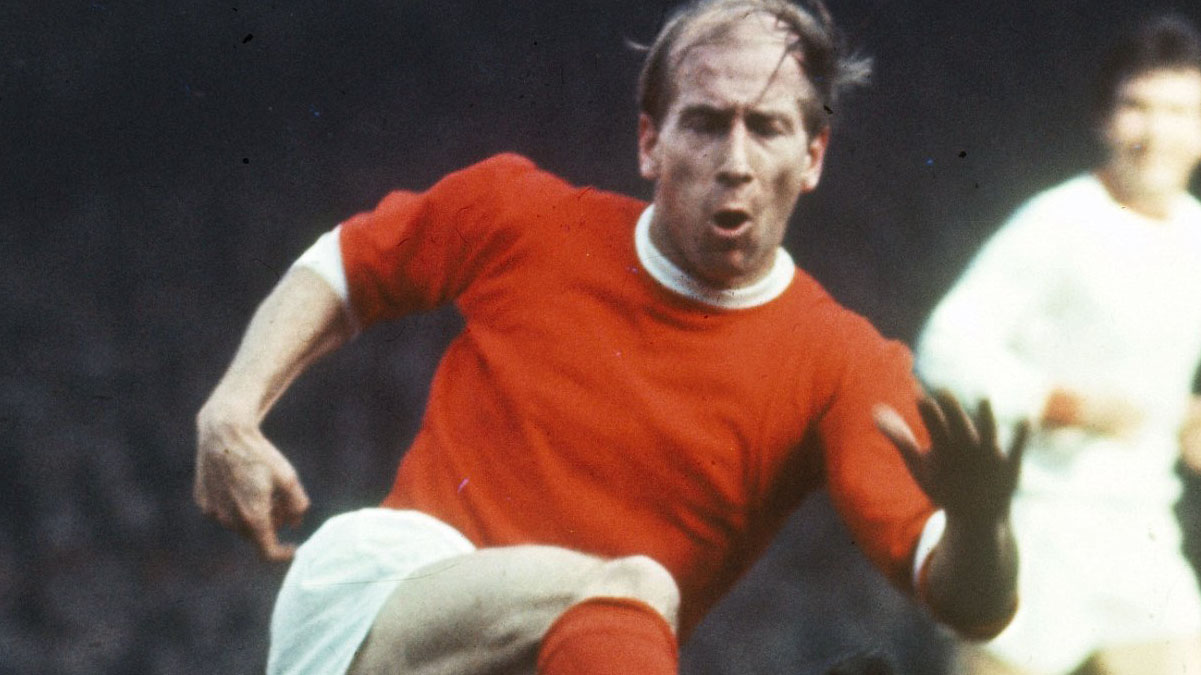
Written by John White for Manchester United Did You Know That
It was 65 years ago today that Bobby Charlton made his first team debut for Manchester United.
“Doing easily what others find difficult is talent: doing what is impossible with talent is genius.” (Henri Fredric Amiel) Bobby Charlton did things with a football that came so naturally to him, whilst others less gifted thought was pure genius. He was given a talent and for 19 years he devoted that talent to Manchester United Football Club.
He had United running through his veins, the club was part of his DNA, having signed for them in January 1953 aged 15 after he left school. On his 17th birthday, 11 October 1954, he signed professional terms with United and after helping the Manchester United Youth Team win the FA Youth Cup in 1954, 1955 and 1956, scoring in the latter two finals, Matt Busby decided that it was time to give an 18-year old Charlton the opportunity to see if he could handle the professional game.
In their opening 9 games of the 1956-57 English First Division season, United, the defending Champions, were unbeaten, winning 7, drawing 2, scored 23 and conceded 10. It was very tight at the top of the table. United led the way on 16 points, closely followed by Tottenham Hotspur and Leeds United who both had 15 points but each had played one game more than United.
Busby never changed his side once: Ray Wood, Bill Foulkes, Roger Byrne (Capt), Mark Jones, Duncan Edwards, Eddie Colman, Johnny Berry, Liam Whelan, David Pegg, Tommy Taylor and Dennis Viollet. The front pair of Taylor and Viollet had plundered 14 League goals between them. But for United’s tenth game of the League campaign, an away game versus Arsenal on 29 September 1956, Busby decided to hand Ronald Cope his debut and rested Jones.
Six days before his 22nd birthday, Cope who was a member of United’s successful 1952-53 FA Youth Cup winning side, played in United’s 2-1 win (scorers: Berry & Whelan). Three days before the trip to London, Jones picked up a knock in United’s 10-0 mauling of the Champions of Belgium, RSC Anderlecht, in the 2nd leg of their Preliminary Round tie in the European Cup (scorers: Viollet 4, Taylor 3, Whelan 2, Berry).
Having won the 1st leg 2-0 (scorers: Taylor & Viollet) in Belgium two weeks earlier, the 10-0 home win (played at Maine Road as Old Trafford did not have floodlights at the time) gave United safe passage into the First Round of the competition with a 12-0 aggregate victory.
United’s next League game was at home against Charlton Athletic on 6 October 1956. As United had a European adventure to juggle along with their domestic commitments, a distraction Spurs and Leeds United didn’t have, Busby decided to rotate his squad with one eye on the visit of the West German Champions, Borussia Dortmund, for the 1st leg of their European Cup First Round match-up on 17 October 1956.
Busby gave Geoff Bent his seventh game in place of Byrne, Wilf McGuinness took the place of Edwards in the side to make his fourth appearance and Bobby Charlton was handed his first team debut. Matt Busby’s maxim was always the same when it came to making decisions about his team selection: “If they are good enough, they are old enough.”Although Bent was 24-years old, Charlton was just five days shy of celebrating his 19th birthday and McGuinness would turn 19 exactly a fortnight after Bobby.
McGuinness had played in the same three FA Youth Cup winning teams as Charlton. Busby’s philosophy was to develop his young players in the United Youth System to get them to learn the “United Way.” Then, when he decided to place his trust in one of them and call them up to play for the senior side he was confident in the knowledge that his young charge would be able to fit seamlessly into his team and repay his manager’s trust in his abilities.
If a young player was told by Matt Busby that they were good enough to play for his team it made that player walk a little taller. Busby had no time for Prima Donnas, players’ egos or tantrums. He wanted his players to do exactly what he asked of them, nothing fancy, just play each game as one solid unit and not as eleven individuals. Just as the Dalai Lama’s young priests gave him their undivided attention, Busby’s players would walk through walls for him.
When Bent made his debut on 11 December 1954, aged 22, he had one of the biggest pair of boots to fill which he helped to clean in the Old Trafford Boot Room. He stood in at left-back for the club captain and England international, Roger Byrne, and helped United to a comfortable 4-2 win over Burnley at Turf Moor, Burnley in the English First Division (scorers: Colin Webster 3, Viollet). He had not let his manager down and similarly when the 17-year old McGuinness made his first team bow in place of Fred Goodwin, he too never failed his manager’s faith in him.
United defeated Wolverhampton Wanderers 4-3 at Old Trafford in the League on 8 October 1955 (scorers: Taylor 2, John Doherty & David Pegg). Faith is about believing. You don’t know how it will happen. But you know it will. It comes from within.
Now it was the turn of Robert Charlton to repay his manager’s faith in him when he pulled on the famous red Manchester United No.9 jersey which had been worn by United’s, and England’s prolific centre forward, Tommy Taylor, in United’s previous 10 League games of the season plus their two matches in Europe in which he scored 9 times. No pressure then on the young boy who was born in Ashington, Northumberland and who came from a football dynasty of a family on his mother’s side, Elizabeth Ellen “Cissie” Charlton (née Milburn).
His Uncles were George Milburn (Leeds United & Chesterfield), Jack Milburn (Leeds United & Bradford City), Jim Milburn (Leeds United & Chesterfield) and Stan Milburn (Chesterfield, Leicester City & Rochdale Rovers). His Mum was a cousin of the legendary Newcastle United and England international striker, Jackie Milburn. Milburn was nicknamed “Wor Jackie” and scored 177 League goals for Newcastle United in 353 appearances from 1943-57 and 10 times for England in 13 international appearances (1948-55).
After leaving Newcastle United he signed for Linfield in Belfast, Northern Ireland where he continued to leave the back of the opponents’ net bulging, scoring a remarkable 68 goals in the Irish League in only 55 appearances during the three years he was there. Charlton always credited his football achievements to his Grandfather, Tanner, and his Mum. Bobby’s older brother, John “Jack” Charlton, worked down the pits at the Ashington Colliery as a miner before applying to join the police, only to also become a professional footballer with Leeds United.
His father, Robert “Bob” Wallace Charlton was also a mine worker. Things did not come easy to the Charlton family. The team Busby selected to play Charlton Athletic was:Ray Wood, Bill Foulkes (Capt), Geoff Bent, Mark Jones, Wilf McGuinness, Eddie Colman, Johnny Berry, Liam Whelan, Bobby Charlton, Dennis Viollet, David PeggThe visitors took a shock lead in the 24th minute with a goal from Fred Lucas but straight after the resulting kick-off Berry made it 1-1 (25th minute), scoring his fourth League goal of the season.
Charlton then made it a debut to remember scoring a brace of goals in the 32nd and 37th minute to put United 3-1 up. But the visitors weren’t giving up and pulled a goal back in the 40th minute. Whelan, who had been United’s star performer all season, sealed victory for United in the 65th minute when the Republic of Ireland international winger scored for the sixth League game in a row, his eighth League goal of the campaign.
In United’s 4-1 win over Charlton Athletic, the young Charlton had slotted into the United team like a hand slipping into a silk glove. He, like so many Youth Team players before him, didn’t let Jimmy Murphy, who was in charge of United’s Youth Team, or Busby down. Charlton played a further 13 League games in season 1956-57, scoring another 8 times, to help United win back-to-back English First Division titles.
He also made one appearance in the 1956-57 European Cup, scoring in United’s 2-2 draw with the defending Champions of Europe, Spain’s Real Madrid, in the 2nd leg of the semi-finals at Old Trafford (Taylor also scored). However, the result wasn’t good enough to reach the final of the competition having lost the away leg 3-1 (scorer: Taylor).
Over the following 17 seasons Charlton starred for club and country helping United win 3 English First Division Championships, 1 FA Cup, 4 FA Charity Shields and the European Cup in 1968.
In 1966, he played in the FIFA World Cup final with his brother, Jack, and his United teammate, Nobby Stiles, when England were crowned World Champions after defeating West Germany 4-2 after extra-time at Wembley Stadium, London. In 1966, the movie “A Man For All Seasons,” was screened for the first time.
The title reflects the playwright, Robert Bolt’s portrayal of Sir Thomas More, the 16th Century Lord Chancellor of England who refused to sign a letter asking Pope Clement VII to annul the marriage of King Henry VIII of England to Catherine of Aragon and to take an Oath of Supremacy which declared King Henry VIII the Supreme Head of the Church of England, as the ultimate man of conscience. More remained true to his principles and religion despite the circumstances at all times.
Bobby Charlton was a man of conscience, his Oath of Supremacy was to Busby and United and he stuck to his principles throughout his career.Bobby Charlton was Manchester United’s “Man for 17 Seasons.”
https://www.youtube.com/watch?v=0TuyCnyiz0o
Did You Know That?
The German Press nicknamed Bobby Charlton “Boom Boom” because he had a cannon of a shot. Duncan Edwards was also known by the Germans as “Boom Boom,” a nickname he received after scoring a thunderbolt of a goal against West Germany at the Olympiastadion, Westend, Berlin, West Germany on 26 May 1956. Edwards was still only 19 when he played against the reigning FIFA World Cup holders alongside his United teammates, Roger Byrne and Tommy Taylor, and despite it only being his ninth cap for his country he ran the show from start to finish.
In the 26th minute Edwards collected the ball and bulldozed his way through three German defenders before unleashing a 30-yard shot which almost put the netting in the stand behind it. England won the game 3-1 and Edwards was carried off he pitch by several of the 50,000 troops among the 100,000 in attendance who were stationed in the British occupied zone of Berlin. United’s Ray Wood and Johnny Berry were among the unused substitutes.
The next morning the German Press likened Edwards to a tank whilst one writer called him “Boom Boom” writing that he had a shot which was as powerful as “Big Bertha,” the German siege Howitzer light naval cannon which the Imperial German Army used to bombard British fortifications during the First World War. A while later the England captain in the game, Billy Wright (Wolverhampton Wanderers) wrote: “There have been few individual performances to match what he produced that day. Duncan tackled like a lion, attacked at every opportunity and topped it off with that cracker of a goal.”
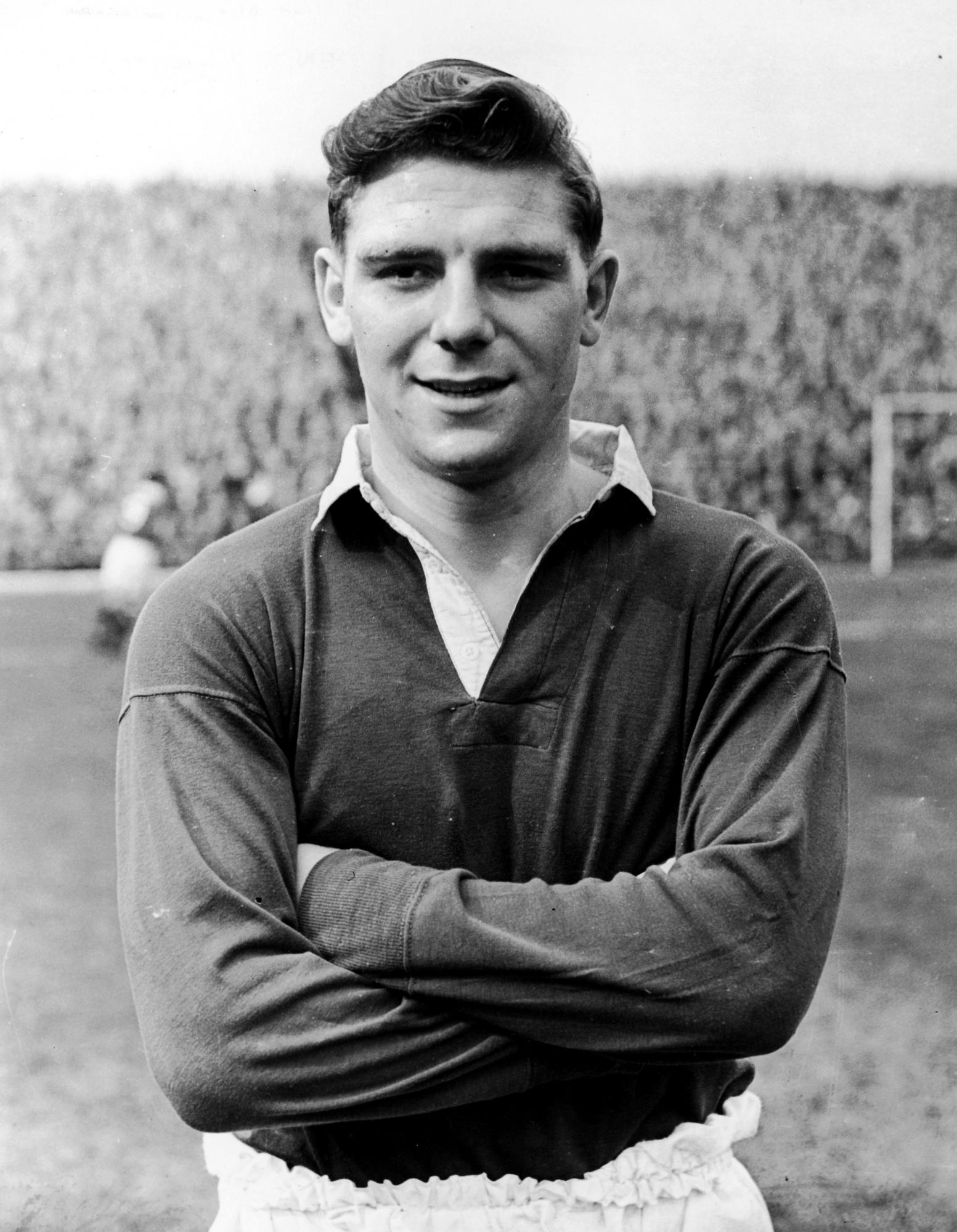
Written by John White for Manchester United Did You Know That
Duncan Edwards was born on 1 October 1936 at 23 Malvern Crescent, Woodside, Dudley, Worcestershire (registered in Dudley, December 1936), to Gladstone and Sarah Anne (née Harrison) Edwards. He weighed 9lbs 8oz at birth, which was a good start to life for him given the living conditions in the coal and iron producing market town of Dudley. Many babies born at the time were simply just too frail to survive life in a post Great Depression world with many succumbing to pneumonia and typhoid, two of the biggest causes of deaths in infants in the late 1930’s. Not long after he came into the world, Duncan and his family moved to the nearby Priory Estate and their new home, which in comparison to many others in the town, was relatively luxurious in that it had a garden front and back, a bathroom and an indoor toilet. However, his father ensured that his son never thought of himself as being better than any of the other children he played with or went to school with. Respect played a major part in Duncan’s life long before he kicked a football for the very first time.
He attended Priory Primary School and Wolverhampton Street Secondary School, Dudley. And, like so many other young boys did on their way to and from school, Duncan dribbled a football along the pavement, in the school playground and on the streets near his house from morning to night at weekends. He was in love with football and even at an early age he set himself on a course to becoming a professional footballer. By the time he was playing for his junior school his football talent was already being noticed. One of his schoolmasters, Geoff Groves, was watching the 11-year-old Duncan one afternoon and noted that during a school training match that his pupil: “Told all the other 21 players what to do and where to go and that included the referee and linesmen!” That same schoolmaster later wrote to a friend: “I have just seen a boy of 11 who will play for England one day.” How right Mr Groves prophecy proved to be. When he was 13, Duncan wrote a school essay in which he spoke about “playing at Wembley Stadium.”
The young Edwards played school football with Wolverhampton Street Secondary School, where his skills and talent were harnessed and he was soon playing regularly with Dudley Schoolboys, where his cousin Dennis Stevens was captain, and his teammates were three years older than him, then Worcester County XI followed by the Birmingham and District team. Despite being the youngest player on the pitch in most of the games he played in, he dominated his opponents. He was a man in a young boy’s body which was still developing. Still not a teenager, his mature physique was backed up by an extraordinarily self-confident mentality. In 1950, he was invited to play for the England Under-14s against Northern Ireland Under-14s at Boundary Park, Oldham, England where he was played up front. Every time he received a junior call-up to the England ranks, his schoolmates would tease him, but in a good-natured way, ruffling his hair as he cowered, embarrassed at his fame amongst his peers.
Duncan was fearless in the tackle and with legs like oak trees he was remarkably very light and nimble on his feet. He seemed to glide across the grass or, more often than not, skim across the mud. His superb balance may have been down to the fact that when he was very young he had taken an interest in the less macho activities of Morris and sword dancing, which led to his Arts & Folk teacher, Mrs Cook, saying of her former star pupil: “He was so light on those feet with bells on the ankles; so beautifully balanced, so dainty.” But dainty was not a word anyone could use about Duncan’s style of play.
Shortly after he penned his essay, he was selected to play for England Schoolboys before a crowd of 100,000 fans. He was still only 13-years old, two years below the age group for that junior level of schoolboy international football. All of the top scouts from the leading clubs in England were at the game hoping to be the man who would be credited with spotting the next Tom Finley, Nat Lofthouse, Stanley Matthews, Jackie Milburn or Billy Wright. And, it was the youngest player on the pitch, Duncan, who was the game’s outstanding player that day on the hallowed Wembley turf. One scout was heard to remark: “By God, they’ve got a good ‘un there!” Duncan played for England Schoolboys for the next two seasons. On 7 April 1951, he won his second cap for England Schoolboys versus Wales Schoolboys with his name appearing in the match programme as: “Left-half, D. Edwards (Dudley).” Another crowd of 100,000 fans were in attendance, the vast majority of them young schoolboys who looked on that day in the hope that they would become the next Duncan Edwards. England’s outside-left that afternoon was “D. Pegg (Doncaster).” David Pegg had signed as an apprentice with Manchester United on 20 September 1950, the day of his 15th birthday. Duncan and David would go on to become Busby Babes and play in the same team together and sadly, both young men would lose their lives in the Munich Air Disaster on 6 February 1958. In 1952, the same year he signed as an apprentice for Manchester United, Duncan captained England Schoolboys. Although he was originally an inside-forward, Edwards’ favoured position was left-half where he could control the flow of games with his dominant style of play.
Given his meteoric rise through the junior ranks, Duncan was a marked man. The coaches of opposing teams would single Duncan out telling his young charges that if they could take him out of the game then they stood a chance of winning it. However, saying it was one thing but achieving it was something completely different. Trying to negate Duncan’s style of play was like trying to put a forest fire out. You could dampen down parts of it and even quell it for a while before it came raging back at you with greater intensity than before. His ability and willingness to take on any challenge, no matter how tough, was all about bettering himself, never about humiliating opponents for the sake of it. Even throughout his many battles he maintained the manners and honesty his parents had taught him. “Admittedly he had a big mouth, coming from a rough background, but I do not think anyone ever took exception as his advice, like his play, was so impressive. He had quietened down considerably by the time he reached 14,” Mr Groves once said. Indeed, later in his career, when he was lining up alongside Newcastle United’s legendary striker Jackie Milburn, he leaned over to him in the tunnel before a game and said: “I’m a big follower of your career, but reputations mean nothing to me, and if I get a word out of you I’ll kick you over the stand. Ok chief?” To say that to any fellow professional would be unthinkable, but to do so in the face of such an established star at such a precocious age was bordering on the arrogant – except Edwards was not a bragger. He backed up any claim he made on the pitch, and that was where it was left as far as he was concerned. He was the ultimate professional, a teetotaller. Outside football he was known to be a very private individual, whose interests included fishing, playing cards and visiting the cinema although he did also enjoy going along to the occasional dance.
Two ever presents watching his early games, apart from his family, were Joe Armstrong, one of Manchester United’s leading scouts and the club’s Midlands scout, Jack O’Brien. Armstrong realised Edwards’ talent as soon as he saw the teenage star trap a football with consummate ease despite the fact that the pitch beneath the young boy’s feet resembled a quagmire and when the leather laced football fell down from the sky, it practically weighed the same weight as a bowling ball. Duncan knew Jack and Joe were watching him but the fact that he was being eyed-up as a potential Busby Babe by two of Manchester United’s top scouts in the country, Edwards did not try to impress his onlookers with any party tricks or fancy play. Duncan was never a showman. He didn’t need to try and emphasise his talent by attempting something foreign to his style of play, because he was, despite his young age, the finished article as a player.
However, O’Brien and Armstrong were not the only scouts showing a keen interest in Duncan as several clubs, including clubs close to his home, Wolverhampton Wanderers situated just six miles away and the Birmingham based trio of Aston Villa, Birmingham City and West Bromwich Albion. But Duncan had always set his heart on playing for Manchester United and it was O’Brien and Armstrong who helped the young boy from a modest upbringing in the Black Country to fulfil his dreams and become a Manchester United player.
The day after the game in which Duncan captained the England Schoolboys side, O’Brien placed a handwritten letter on Busby’s desk at Old Trafford. It simply read: “Have today seen a 13-year-old schoolboy who merits special watching. His name is Duncan Edwards, of Dudley. Instructions please.” Busby put pen to paper and instructed his leading Scout, Bert Whalley, to “Please arrange special watch immediately – MB (Matt Busby).” Whalley did as instructed and when he saw him play, he could not believe the talent the young Edwards possessed and the maturity of his play despite his tender age.
On 31 May 1952, Jimmy Murphy and Bert Whalley, secured the 15-year old schoolboy’s signature as an amateur at Duncan’s home on the Priory Estate, Dudley. Acquiring the prestigiously talented Edwards was a major coup for Manchester United. It sent out a message to every other club in the land that a young player’s place of birth, or his support for his local hometown club, meant nothing if the boy had his heart set on one day pulling on the famous red jersey of Manchester United. Schoolboys up and down the land wanted to follow his path to Old Trafford.
Before she died aged 93, Duncan’s Mum told how the Wolverhampton Wanderers manager, Stan Cullis, used to call round to the Edwards’ family home quite regularly in the hope that he could persuade Duncan to sign for Wolves. “He used to sit outside the house in his car, waiting for Duncan to come home from school. Wolves were a big club then. It was always them and United trying to outdo one another in those days. Mr Cullis was a lovely man, but I think he knew all along that he was wasting his time. My Duncan only ever wanted to play for United. I don’t know what it was about Manchester United. He seemed to be attracted to them for some reason. It’s lovely that they still remember him, isn’t it? Whenever I visit his grave there are always some messages and flowers from supporters who have been to the graveyard.”
At the 1976 Summer Olympic Games hosted by Montreal, Canada, the Romanian gymnast, Nadia Comaneci, became the first gymnast in Olympic history to be awarded the perfect score of 10.0 for her performance on the uneven bars. Omega SA, the Swiss company which manufactured the electronic scoreboards for the Games, were led to believe that no gymnast would ever be awarded the perfect score and therefore their numbering system only went up to 9.9. Thus, when her score was displayed it came up as 1.0 which was the only way the panel of judges could show that the 14-year old had in fact reached perfection. She went on earn a further six 10.0’s at the XXI Olympiad.
Whenever Duncan took to the pitch, Armstrong had already scored him a perfect 10 before he even touched the football because it was impossible for Duncan to try and up his game to try and impress. He was like a Rolls Royce as he cruised his way through any obstacle in front of him. Even the legendary Bobby Charlton, a former teammate of Duncan, once said of him: “He was the best player I’ve ever seen and the best footballer I ever played with. I always felt I could compare well with any player – except Duncan. He was such a talent, I always felt inferior to him.” On 1 October 2016, Sir Bobby Charlton unveiled a plaque at a ceremony in Dudley, close to Duncan’s home and told those in attendance that Duncan’s death was “the biggest single tragedy ever to happen to Manchester United and English football.” In a moving tribute from the United great he told the crowd in attendance that Duncan had been “like a brother” to him. The event took place on what would have been Edwards’s 80th birthday. The blue plaque features the words: “Duncan Edwards, Footballer of genius, b Dudley 1934 d Munich 1958, Player for Manchester United and England, Grew up on the Priory Estate and attended Priory Primary School.” It also includes the famous quote from Edwards’ primary schoolmaster in Dudley, Geoff Groves: “I have just seen a boy of eleven who will play for England one day.”
Aged 16 years and 185 days old, Busby knew he could no longer hold back Duncan’s progression to the first team. On 4 April 1953, Busby handed him his first team debut but it wasn’t a game Duncan cared to remember as United were beaten 4-1 at Old Trafford by Cardiff City in the English First Division (scorer: Roger Byrne). He did not feature again in Busby’s side for the remaining five League games. Duncan subsequently signed his professional contract with Manchester United on 1 October 1953, the day of his 17thbirthday. Duncan’s reward was a paltry £15 weekly pay packet during the season reducing to £12 a week during close season. After his death, neighbours of Duncan’s parents told a story that a new washing machine was delivered to the Edwards’ house on the day that Duncan signed for Manchester United. These were the pre-big signing on fee days of the beautiful game which was, in many ways still enjoying a certain degree of innocence and lack of corruption, although a washing machine in 1952 was considered to be a luxury item.
After arriving at Old Trafford, the young Edwards quickly settled in with his landlady at 19 Gorse Avenue, Gorse Hill, Stretford, Manchester. Today a blue plaque is on the wall of the house which reads:
“DUNCAN EDWARDS (1936-58), Manchester United and England footballer lived here. He was one of eight “Busby Babes” who lost their lives in the Munich Air Disaster.”
During his childhood his family couldn’t afford a summer holiday, money was tight in the household, but after he arrived at Old Trafford, Jimmy Murphy took him under his wing and became like a second father to him. During the close season the Murphy family would take Duncan and his colleague Wilf McGuinness to the Emerald Isle, with the seaside town of Bray in County Wicklow, Republic of Ireland a favourite destination. Murphy was the Patriarch to all of Manchester United’s youth team players. The boys idolised him and his love for them showed no bounds. Although Jimmy would always say that he did not have a particular favourite young player, Duncan was always very special to him and remained close to his heart until Jimmy died on 14 November 1989.
“He might have been the Koh-i-Noor diamond among our crown jewels, but he was an unspoiled boy to the end, his head the same size it had been from the start. Even when he had won his first England cap but was still eligible for our youth team, he used to love turning out with the rest of the youngsters. He just loved to play anywhere and with anyone.” – Jimmy Murphy
Duncan won the FA Youth Cup with the club’s Youth Team in 1953, 1954 and 1955.
Although he owned a car, he could not drive and instead he would cycle to and from Old Trafford on his Raleigh bike. Following a game which United lost, he was cycling home and was stopped by a policeman for not having lights on his bike. He was fined 10 shillings in Manchester Magistrates Court and a further 2 weeks’ salary by Matt Busby for bringing the club’s name into disrepute. In one season he played more than 100 games – Manchester United, England and his National Service Regiment.
Duncan won the first of his 18 full international caps on 2 April 1955, in a 7-2 mauling of Scotland at The Empire Stadium, London in the British Home International Championships. His club captain, Roger Byrne, also played in the game. He was aged just 18 years and 183 days.
“I played for Scotland when Duncan Edwards made his debut for England as an eighteen year old at Wembley Stadium in 1955. England won 7-2 and Dennis Wilshaw of the Wolves scored 4 goals – but it was Duncan Edwards who was the star of the show. Duncan was the complete footballer and there is.”
Tommy Docherty, Preston North End
The loss of 8 Busby Babes in the Munich Air Disaster also affected Armstrong immensely but the United scout knew that the club needed him to be there to help Murphy rebuild a team as Busby lay in a hospital bed in Munich, West Germany fighting for his life following the horrific injuries he sustained in the crash. Busby had not long been out of hospital before the trip to play Red Star Belgrade in the Yugoslavian capital on 5 February 1958. He had undergone a minor operation on his legs. Murphy missed the trip to United’s European Cup, quarter-final, second leg tie as he was in charge of Wales that same evening United played in Belgrade. The Welsh were playing Israel in Cardiff, Wales in a play-off game for the 1958 Fifa World Cup finals hosted by Sweden. Murphy later said: “I usually sat next to Matt on the plane and had the next room to his at the hotel whenever the team went away and I had suggested that I went to Belgrade, with it being such an important European Cup game. He had said, “No, Jimmy, you have a job to do,” so (the coach) Bert Whalley went to Belgrade in my place.” Bert lost his life in the air disaster.
“The name of Duncan Edwards was on the lips of everyone who saw this match; he was phenomenal. There have been few individual performances to match what he produced that day. Duncan tackled like a lion, attacked at every opportunity and topped it off with that cracker of a goal. He was still only 19, but was already a world-class player.” – Billy Wright
Billy Wright, England captain was speaking about Duncan’s performance on 26 May 1956 in an international versus the reigning Fifa World Cup holders West Germany, at the Olympiastadion, Berlin. With the score standing at 0-0 with 25 minutes to go, Edwards produced his finest strike on the highest stage of elite football. Duncan gained possession halfway inside the German half and set off on a run, cutting through the German defence like a hot knife going through butter, before he unleashed a thunderbolt of a shot from 20 yards out which almost ripped the back of the net off its fastenings. England went on to win the game 3-1 with the German press nicknaming Edwards “Boom Boom” such was the accuracy and velocity of his strike at goal. Back home he was simply known as “The Tank,” an apt description for an unmovable object who was a colossus of a footballer. Roger Byrne also played in the win over West Germany whilst two other United players were unused substitutes: goalkeeper ray Wood and Johnny Berry.
On 29 April 1958, Murphy wrote to his trusted friend, Armstrong, to thank him for everything he had done post Munich. Joe had been like a rock to Jimmy during the club’s darkest hours. The letter reads:
“My Dear Joe,
Do hope all is well with your good self and Sally.
I wish to sincerely thank you Joe for all the grand work you have done for me. I really mean this, without you around I could not have carried on.
As you know there are a hundred problems to sort out every day and you know the answer to most of them.
Have Enclosed 2 15/~ tickets which no doubt you will be able to use.
Jimmy”
The two tickets were for the 1958 FA Cup final on 3 May 1958, which Murphy, aided by Armstrong, incredibly helped Manchester United reach just 86 days after the club’s darkest day when seven Busby Babes were killed instantly in the air crash in Munich on 6 February 1958, whilst an eighth Babe, unquestionably the greatest of them all, Duncan Edwards lost his own brave battle for life fifteen days after his teammates.
“He fought for his life, you know. He really fought. He was strong but, in the end, his injuries were too much. With modern medicine, he would have been kept alive, but they told me he would never have been able to play football again. And I don’t think he could have lived with that.” –Sarah Anne Edwards, Duncan’s Mum before her death in 2003
Duncan was well liked by all of his teammates. They all knew he was a better player than them but Duncan never disrespected any of them. If anything, he was like a junior coach to them, always willing and able to pass on a training tip or two. Indeed, a few days before he flew to Belgrade, the manuscript of his book entitled “Tackle Soccer This Way,” was delivered to his publishers and it was later printed word for word as he wrote it. In his book Duncan offers young players hundreds of football tips such as: “Always respect the referee and be reasonable at all times.” Sound advice from such a young player himself.
Johnny Giles (Manchester United 1959-63) Giles, once told a story about arriving in Manchester as a youngster from Dublin, Republic of Ireland in 1955 and taking the bus to Old Trafford with Joe Armstrong. “As the bus stopped outside Old Trafford we got off and sitting on top of the post box waiting for his bus home eating an apple was Duncan Edwards. He was eighteen years of age, already an England international, and widely regarded as the best young footballer of his generation. He said ‘hello’ and then continued eating his apple. That was Duncan.”
More than 5,000 people turned up for Duncan’s funeral in Dudley on 26 February 1958, where a heartbroken and tearful Jimmy Murphy addressed the congregation and said: “If I shut my eyes I can see him now. His pants hitched up, the wild leaps of boyish enthusiasm as he came running out of the tunnel, the tremendous power of his tackle – always fair but fearsome – the immense power on the ball. In fact the number of times he was robbed of the ball once he had it at his feet could be counted on one hand. He was a players’ player. The greatest English footballer of all time… that was Duncan Edwards.”
Duncan’s mother stood shoulder to shoulder with the thousands who turned out to pay their respects to her son, still her little boy aged just 21, as his cortege made its way to St. Francis’s Church, Dudley. Back in Manchester, the United fans paid their own condolences to one of their own where it seemed like the sky was weeping for the loss of 8 young men.
Prior to the disaster, Duncan’s father worked at the local Beans Industries factory in Tipton, just a short work from the Edwards’ family home. However, after Duncan’s death, Gladstone never went back to work in the factory. Instead, he went to work at Dudley Cemetery where Duncan and his sister Carol Anne, who had died in 1947, aged just 14 weeks, were buried. His job was to maintain and clean the gravestones including those of his daughter and son.
In 1961, Matt Busby unveiled a stained glass window in St. Francis’ Church which depict Duncan in his Manchester United and England shirts. There is also a coat of arms of Manchester United and Munich. Tens of thousands of United fans have visited the Church to view these memorials whilst many fans travel to Munich every year on the anniversary of the disaster. Duncan’s grave lies in Section C, Plot 722 of Dudley Cemetery and more than 63 years later, there are fresh flowers laid at his grave every day which has a six-foot black granite headstone. The headstone bears an engraving of Duncan taking a throw in and, on the grave, is a black granite vase and another vase in the shape of a football. There are usually a fresh bunch of red and white carnations filling the black granite vase. John Phillips, Dudley Borough Council’s Assistant Cemeteries and Crematorium Manager, said: “Visitors come to the grave all through the year. It is still a shrine. It is hard to put a figure on the numbers who come here each year. It’s not only individuals who come to stand in silent respect at the grave, but whole parties, as if on a pilgrimage.”
“The bigger the occasion, the better he (Duncan) liked it.” – Sir Matt Busby
There is also a permanent Exhibition dedicated in memory of Duncan Edwards in Dudley, The Duncan Edwards Museum, which features his trophies, medals and newspaper cuttings. His England caps and shirts are on display in the Old Trafford Museum. On the top step reads the name of captain Roger Byrne. Inside the museum takes you through Duncan’s early life from 23 Malvern Street to 31 Elm Road; the walls are filled with original photos of his favourite footballers from the 1940s and hanging from the bed is a gas mask, reminding people this lad grew up when the world was still at war. There is a dedicated area to the Munich tragedy and a memorabilia-filled cabinet dedicated to each of the Busby Babes. The museum also covers Duncan’s time performing National Service with many testimonies, including from Walter Winterbottom, who described Duncan: “as the spirit of British football.” It was Winterbottom who awarded Duncan all 18 of his senior England caps. Also featured is the Coronation Street creator Tony Warren who was Duncan’s friend, together the pair jived in the dance halls of 1950s Manchester.
During the 1956-57 season, several of Busby’s young stars, notably Bobby Charlton and Duncan Edwards, were encouraged by their manager to follow in his footsteps and do their National Service. Charlton aged 19 and Edwards aged a year older like many professional footballers from the Midlands and north-west, were posted to Nesscliffe, Shropshire and played for the Nesscliffe Army Royal Army Ordnance Corps football team.
Duncan finished his National Service in 1957 and Bobby left Nesscliffe in 1958.
Prior to the 60th anniversary of the Munich Air Disaster Derek Thorpe, who served with the Kings Shropshire Light Infantry at Copthorne Barracks, Shrewsbury was asked about his memories of the famous United pair when he played against them. “Because they were just up the road from us, we would play each other a lot. They were a cut above the rest. They had a lot of players from different clubs, there was a player from Everton, and another one from Blackpool,” said Derek who himself was a nippy winger. Derek recalled one game in particular between the two army sides when his sergeant-major warned his team that the Nesscliffe lads had a few tasty players in their side. Not long into the game Derek was bearing down on goal when he was dispossessed by a strapping defender. Derek immediately set about paying his opponent back saying: “He tackled me early on, and I thought ‘I’ll get have you next time’. I didn’t half know about, I landed about two yards further up the pitch than I did the first time.” The player was none other than Edwards who was already a leading figure in the United side and had been capped by England three times. Derek said he was in total awe of the power, skill and speed of the Busby Babe. “Him and Bobby Charlton were both in the same team, and they really stood out. I thought Duncan Edwards was better than Bobby Charlton, and I later read that Bobby Charlton also thought he was. They were such great lads. Duncan was from Dudley, and I was from Dawley, so the lingo was pretty similar. After he had knocked me flying with his tackle, he came over to me, and said ‘you all right, kid?‘”
Brian Griffiths who played at full back for Shrewsbury Town also played for the Nesscliffe Army Royal Army Ordnance Corps football team. Charlton arrived at the Nesscliffe depot shortly after Brian and the pair were in the same platoon, 3 Platoon, and they shared the same platoon billet. “Duncan was already there. He was a PTI, a physical training instructor. He was a corporal. We had a good old natter and he explained everything to us. I knew him as Dunc. He was a smashing lad. He was big, and so gentle, and yet when he said something, you automatically did it. He was not aggressive, and his football capabilities were just unbelievable,” said Brian. The platoon trained at Shropshire Racecourse, Monkmoor Road, Shrewsbury. “We would do the normal training the soldiers did – marching, ammunition and so on – and then after that the footballers would do the football training. We were all mates and it was a good atmosphere,” said Brian. Charlton played at inside forward or centre forward but Brian recalls that it took Edwards to get the best out of his United teammate. “Bobby does owe Dunc quite a lot. Over the time I knew him he improved to A1. He did not use his body, like a defender does. He was always looking to try and pass people, even if they had the ball. He had no aggression – we used to say to him: ‘Bloody get in!’” added Brian.
Derek was impressed with how the Busby Babes slotted in very easily to army life, and got on with all the other soldiers during their Shropshire army days. “They were great lads, they really were. You could talk to them easily, it was just normal army chat. At one point I was injured, and I finished up in the medical centre at Nesscliffe, and I remember Duncan and Bobby Charlton coming to visit me. They mucked in with everything and they never thought they were any higher than anybody else,” added Derek.
There is also a Duncan Edwards Close, a Duncan Edwards Way and a Duncan Edwards Games Area, which was opened by Sir Bobby Charlton in 2006.
In 2002, Duncan Edwards was inducted into the inaugural English Football Hall of Fame at the National Football Museum in Manchester.
During his career he played 177 times for Manchester United and scored 21 goals (1953-58). Between 1949-52, he represented England Schoolboys on 9 occasions: played 4 games for the England “B” team from 1953-54: was awarded 6 England Under-23 caps from 1954-57, scoring 5 times and was capped at full international level 18 times and scored 5 goals (1955-57).
Many football pundits have said that had Duncan survived the Munich Air Disaster and was able to play again after recovering from his injuries, then it would have been him, and not Bobby Moore, who captained England to Fifa World Cup glory in 1966. Bobby was 25 when England defeated West Germany 4-2 in the final at Wembley Stadium on 30 July 1966, whilst Duncan would have been 29.
“When I used to hear Muhammad Ali proclaim to the world that he was the greatest, I would always smile. The greatest of them all was a footballer named Duncan Edwards.” – Jimmy Murphy
For all Manchester United fans everywhere, Duncan Edwards is a Light that will never go out.
Did You Know That?
Speaking before her own death in 2003, Duncan’s mother, Sara Anne, recalled her son’s last words to her which were: “Come on Mum, get me home. I can’t miss Wolves on Saturday.”
Written by John White for Manchester United Did You Know That
1967 may well have been the Summer of Love, but in May 1967, no Man Utd fans were sticking a flower in their hair and boarding a plane to make their way to San Francisco, USA. On 6 May 1967, they were wrapping a red, white and black scarf around their necks, pinned a badge to the lapel of their denim jacket which read ”Stretford Enders RULE OK!” and were making their way to Stratford, East London.
Going into the last few games of the 1966-67 season three teams all stood a chance of being crowned Champions of England. For their penultimate First Division game United had an away trip to West Ham United having played 40, won 23, drawn 11 and losing 6, with a goal difference of +38. The teams on their coat tails, Nottingham Forest and Tottenham Hotspur, had two and three League games respectively still to play. Forest, managed by the former Manchester United and Republic of Ireland captain, Johnny “Gentleman” Carey, were chasing their first ever English First Division Championship. Tottenham Hotspur, managed by Bill Nicholson, were chasing their second domestic double in six years after winning the First Division title in 1960-61 and the 1961 FA Cup final under Nicholson. On 6 May 1967, Forest’s second last game of the season was an away fixture at Southampton. They were three points behind United on 54, but with 2 points for a win and 1 point for a draw, they were very much still in the running with 22 wins, 10 draws and 8 defeats, and a goal difference of +23. Spurs were 6 point adrift of United on 51 and their feint hopes of winning their third League crown relied on them winning their last three fixtures, hoping United and Forest would trip up, and Spurs needed to score a bucketful of goals as they had a goal difference of +19. Spurs had won 22, drawn 7 and lost 10 of their 39 League games and a week after the season was due to end they had to play Chelsea in the FA Cup final. But the omens for the London side were not on the favourable side as their Star sign favoured years ending in “01” when it came to winning trophies. They won the FA Cup in 1901, 1921 and 1961 as well as the First Division Championship in 1961 and the 1961 FA Charity Shield. They went on to lift the League Cup in 1971 followed by two more FA Cup final victories in 1981 and 1991.
So when United arrived at West Ham United’s home ground on 6 May 1967, they knew a win would secure the title, regardless of what happened to Forest on the South Coast at The Dell, Southampton and even a draw would almost certainly be good enough to give Matt Busby his fifth League Championship as United manager. Manchester United’s +15 goal difference over Carey’s talented side looked insurmountable. The Forest side included a former United player, Jeff Whitefoot, and a future United player, Ian Storey-Moore. United looked like Champions from the opening game of the season when they smacked five goals past West Bromwich Albion in a 5-3 win at Old Trafford (scorers: Denis Law 2, George Best, David Herd, Nobby Stiles).
But it was the reigning Champions from the previous season, Liverpool, who made all of the early running and had a strong squad which would test any opponent. Liverpool had three players who were members of England’s victorious 1966 World Cup winning squad, Gerry Byrne, Ian Callaghan and in Roger Hunt, they had a prolific who scored goals for fun. Hunt, nicknamed “Sir Roger,” scored 29 goals in 37 League games during Liverpool’s Championship winning season in 1965-66. But United had a trio of players who every side in the League coveted and feared, George Best, Bobby Charlton who actually did become a “Sir” and Denis Law. In January 1967, Liverpool topped the First Division table but after United lost 1-0 at Sheffield United on 26 December 1966, they went on an unbeaten 20 games run up until the end of the season.
A verse from Scott McKenzie’s song “Are you going to San Francisco?” seemed quite apt by the time United arrived in London.
“All across the nation
Such a strange vibration
People in motion
There’s a whole generation
With a new explanation
People in motion
People in motion”
In season 1966-67, Manchester United sent a vibration through every side they met. They were a team in motion, a new generation of United players who in some games defied explanation beating Everton 3-0, Burnley 4-1, Sunderland 5-0, Blackpool 4-0, Leicester City 5-2 and Aston Villa 3-0 at Fortress Old Trafford. Every side which visited Old Trafford, yet to be dubbed “The Theatre of Dreams” by Bobby Charlton, faced a Theatre of Nightmares. Just 36 days before United arrived at the Boleyn Ground, West Ham United visited Old Trafford in the League on 1 April 1967. The visitors were captained by England’s 1966 World Cup winning captain, Bobby Moore, and had two other notable players on display who helped England defeat West Germany 4-2 after extra-time in the 1966 World Cup final, Geoff Hurst and Martin Peters. The United team also had World Cup winning players, Bobby Charlton and Nobby Stiles, but the third Manchester United player who was a non-playing member of the 1966 England World Cup winning squad, John Connelly, left United before Bobby Moore held the famous Jules Rimet trophy aloft on 30 July 1966 at Wembley Stadium, London. Connelly signed for Blackburn Rovers in June 1966 but when England were crowned World Champions, he had not kicked a ball for his new club.
It may have been April’s Fool Day on 1 April 1967, but it was West Ham United who were made fools of on the day when United won the game 3-0. Moore, Hurst and Peters were household names throughout England but the three players who scored for Manchester United in their 3-0 victory were known across the globe. It was their famous trio of Denis “The King” Law, Bobby Charlton, a Busby Babe, and a 20-year old football rebel named George Best. West Ham United’s famous English trio were held in great esteem but United’s famous triumvirate of Law, Best and Charlton made April Fools of Moore and his fellow defenders when the three of them registered their name on the scoresheet with one goal each in United’s comfortable victory.
When Matt Busby threw the curtains wide of his bedroom in Manchester on the morning of the trip to play West Ham United, 6 May 1967, he surely must have woke-up after dreaming of guiding his beloved side to the First Division Championship title. His team were on the verge of winning the club’s seventh First Division title, his fifth in charge of the club he had managed since 1945. But his mind was not cast back to United’s last First Division Championship winning side under his stewardship two years earlier, 1964-65, he reflected on his First Division Championship winning side in 1956-57, his famous Busby Babes side, which saw 8 of his players perish in the Munich Air Disaster on 6 February 1958. And, one day, one game, one performance, one result would surely define Manchester United’s 1966-67 season. But, would his players once again deliver the goods for him? United had went top of the table on 11 March 1967 following a goalless draw against Newcastle United at St James’ Park and had not been off top spot since.
The team Matt Busby selected for the all important game was:
Alex Stepney, Shay Brennan, Tony Dunne, Paddy Crerand, Bill Foulkes, Nobby Stiles, John Aston Jr, George Best, Bobby Charlton, David Sadler, Denis Law.
In season 1965-66, Busby’s goalkeepers, Pat Dunne, David Gaskell and Harry Gregg and they conceded 59 League goals between them from the 42 games played. Gregg was the No.1 choice but his time at Old Trafford was fast approaching, as was his playing career, through injury. Busby did not have the faith in Dunne or Gaskell, who was injury-prone, to help United reclaim the First Division title in 1966-67 and so he dipped into United’s bank account and purchased Alex Stepney from Chelsea in August 1966, a £55,000 record transfer fee for a goalkeeper. Tommy Docherty was the Chelsea manager when Stepney moved to Old Trafford and the pair would team-up once again when Docherty was appointed the manager of Manchester United on 22 December 1972, after Frank O’Farrell was sacked.
The West Ham United versus Manchester United kicked-off in bright sunshine. The red half of Manchester invaded London, the attendance of 38,424 was a post-war record for the Boleyn Ground. The home side had lost their last five games starting with the 3-0 defeat at Old Trafford and during this losing streak they flew to Houston, Texas, USA to play a friendly against the reigning European Champions, Real Madrid. The game was staged as part of several exhibition games to promote football (soccer) in the USA in advance of the United Soccer Association domestic League commencing that summer. The match was played in Houston’s Astrodome which was known as the “Eighth Wonder of the World,” the first ever football match played indoors and on artificial turf. The Hammers lost 3-2 to Los Blancos, Real Madrid’s nickname as they wear an all white kit.
When West Ham United faced United on 6 May 1967, they knew they weren’t going to be relegated and so their manager, Ron Greenwood, decided to give two of their Academy graduates a game, 20-year old goalkeeper Colin Mackleworth for what was only his third senior game and 20-year old winger, Harry Redknapp. United were missing two players who had played key roles in getting United to within touching distance of winning the title. David Herd was still out after breaking a leg six weeks earlier and left-back Bobby Noble, who had played 29 times in the League that season, was involved in a horrific car crash on his way home from United’s 0-0 draw at Sunderland on 22 April 1967. Noble’s injuries were so serious he never played again, a career cut cruelly short at 21 years of age.
United took to the pitch in a gleaming all white kit and by the end of the game the West Ham United players who played against Real Madrid must have thought The Red Devils had been renamed El Diablos Blanco (Spanish for “The White Devils”). United were 1-0 up after only two minutes play with a goal from Charlton, 2-0 up after seven minutes with a headed goal by Paddy Crerand and 3-0 up after ten minutes when Bill Foulkes scored his sixth goal for the club. By half-time the Football League’s engraver could start etching the name of the world’s most famous club, “Manchester United,” on the base of the First Division Championship trophy as they led a mesmerised home side 4-0. Best scored his tenth League goal of the campaign in the 25th minute. The travelling army of United fans were in party mood. After the interval West Ham United pulled a goal back when full-back John Charles scored in the 46th minute. Charles won 5 caps for the England Youth Team and was the first black player to represent England at any level. Even the United fans cheered when Charles scored hoping that United would be stirred back into action and reproduce the kind of football they had been drooling over in the first half. The visitors then turned on the style with the mercurial Best goading the Hammers’ back four to try and get the ball off him as he turned one way, twisted another and spun around his opponents like a spinning top. No wonder Crerand once said that “George Best had twisted blood.” A penalty from Law in the 63rd minute followed by his twenty-fifth goal of the season in the 79th minute which sealed an emphatic 6-1 victory for the new Champions of England. The United fans invaded the pitch and some of them dug out pieces of turf to remember the occasion.
The Hammers were proud of their Academy which produced players such as Bobby Moore, Geoff Hurst and Martin Peters but in Law, Best and Charlton, United had three University graduates. Manchester United’s 6 Star performance was fit enough to be played across the capital in London’s Royal Albert Hall it was that commanding.
Forest lost 2-1 to Southampton and Spurs drew 0-0 away to Liverpool. But Spurs and United would soon be seeing one another again very soon in the FA Charity Shield final as Spurs beat Chelsea 2-1 in the FA Cup final. Tottenham Hotspur had beaten Forest 2-1 in the semi-finals of the competition.
In the music charts Sandie Shaw was at No.1 with “Puppet On A String.” On 6 May 1967, Manchester United pulled all of the strings against West Ham United and produced a master class performance, particularly the Manchester United Puppet Master, George Best. Perhaps Manchester United were the Ninth Wonder of the World.
The Hammers had been well and truly hammered.
Did You Know That?
Bobby Moore holds the unique distinction of captaining three Cup winning teams at Wembley Stadium, London in three consecutive years. In 1964, the 23-year old Moore, was the captain of his club, West Ham United, and England. He skippered The Hammers to FA Cup success in 1964 when West Ham United beat Preston North End 3-2 at Wembley Stadium. Winning the FA Cup meant they qualified for the 1964-65 European Cup Winners’ Cup. West Ham United reached the 1965 European Cup Winners’ Cup final which was hosted by Wembley Stadium. They beat their opponents, 1860 Munich 2-0, and Moore proudly held aloft the club’s first, and only, European trophy. In 1966, Moore was back at Wembley Stadium for yet another final but this time he was captaining his country in football’s biggest final, the World Cup final. England defeated West Germany 4-2 after extra time and was carried around the pitch on his teammates’ shoulders as he held the famous Jules Rimet trophy in the air.
Written by John White for Manchester United Did You Know That
It was 58 years ago this week that a certain young man from east Belfast made his debut for Manchester United. His name is George Best.
“To me, a genius is someone with a brilliant mind who has had great accomplishments in a challenging field, and changed the world in some meaningful way. As vague as this definition may seem, the essence of genius is limitless. There appear to be no bounds to what geniuses can accomplish. To define it much further, is to limit something that is supposed to be limitless.” (I. C. Robledo). George Best was a Genius.
On a bright sunny day on Wednesday 22 May 1946 a baby boy was born in Belfast who would literally change the face of football forever. In June 1945, Dickie Best married his sweetheart Anne Withers and eleven months later the couple witnessed the birth of their first child and named him George after Anne’s father. Has any footballer ever been born with a more suitable name and into such a humble background? Dickie was a modest working class man and a hugely respected figure in the local community of Castlereagh in East Belfast where the Best family lived at Burren Way. Dickie worked at an iron turner’s lathe at the world famous Harland & Wolff shipyard at Queen’s Island, Belfast where the Titanic was built. Anne worked on the production line at Gallaher’s tobacco factory, the largest tobacco factory in the world, located in North Belfast. Dickie was 26-years old when Geordie, as the family called him, was born and played amateur football until he was 36 whilst George’s mum was an outstanding hockey player. From the moment he could walk all George ever did was play football and it was his Granda George who would kick a ball about all day with his grandson. On the other side of the family it was his Granda James “Scottie” Best, who took him to his first football match to see Glentoran play at The Oval in East Belfast, close to James’s house. Well there wasn’t much else for the kids growing up on the streets of post war Belfast to do except play football as very few families had a television set at the time and the only “net” young boys were concerned about in the early 1950s was a make shift goal net made from placing jumpers on the ground.
“In school, children learn that there is only one answer for each question and are requested to conform to conventional social wisdoms. The difference between geniuses and most of us is that they managed to not lose their childhood creativity.” (Andrii Sedniev).
The young George attended Nettlefield Primary School in Radnor Street, Belfast and on his way to and home from school he took a tennis ball out of his coat pocket and dribbled it along the pavement, throwing his hips from side to side as he weaved in and out of men and women on their way to work. These unsuspecting early morning workers were in George’s mind defenders he had to snake past enroute to the goal. When the bell rang to announce the mid-morning break no one at the school had to go looking for George as he was the first out on the school playground waiting for one of the older boys to produce a football for a kick-about. Lunchtime was the same at school, a game of football with jumpers for goal posts, and after school George played football on a strip of grass near his home. It was no wonder George was a skinny kid with all that running about he did and food was the last thing on his mind when his mum had to go looking for him at tea time. It was usually quite dark by the time George got home, perhaps having played football for 4 hours or more at the end of the school day. When all the other kids had been dragged home by their parents George improvised and kicked his tennis ball against the kerb so as it would bounce back to him with George controlling it and passing it against the kerb again. Shooting practice for George was placing the tennis ball on the ground and aiming for the handle of a garage door. George loved Christmas time because that was when he would either receive a brand new football from his parents or a pair of football boots depending on whether his current ball had seen its best days or if his feet had grown too big for the football boots he was wearing at the time.
However, despite football taking up all of his spare time George was an excellent pupil and a very quick learner. He passed the 11-plus and went to Grosvenor Grammar School on the Grosvenor Road, Belfast. George hated the school but not for academic reasons, none of his mates were at the school and worst of all, Grammar Schools in Belfast played rugby, not football. In his first year at Grosvenor George found himself running with an oddly shaped ball in his hands rather than having a football at his feet doing whatever he wanted it to do. But George gave rugby a go and was a half decent fly-half although for George no sport could replace his love for football. George hated going to the school and used to trick his teachers into sending him home thinking he was ill as the shrewd young Best used to suck on a certain brand of “hot” sweet which made his throat turn red. When George started to “go on the beak” (Belfast slang for playing truant) at Grosvenor his parents, sensing he was unhappy there, managed to get him into Lisnasharragh High School. And whereas other young boys at the time, including Alex “Hurricane” Higgins, who were similarly avoiding a school day would make their way to a nearby snooker hall, the young Best made his way to a patch of grass to kick his ball about. Away from school Higgins frequented the Jampot Snooker Club in the Sandy Row area of Belfast whilst George could find a makeshift football pitch almost anywhere. The Hurricane like George was born in Belfast but three years after George and in many ways the lives of the two ran parallel with the highs the duo achieved during their careers followed by the unbearable lows. Alex was as mercurial with a snooker cue as George was with a football, the “George Best of the green baize,” a pair of geniuses although the latter description did not do either man true justice.
George’s new school was in Stirling Avenue and much closer to his home than Grosvenor but more importantly to George Best, all of his mates attended the school and they played football there, not rugby. Despite rugby being the number one sport at Grosvenor High School their rugby team only ever won the top prize in Northern Ireland Schoolboy Rugby on one occasion, lifting the Ulster Schools Challenge Cup in 1983, long after the best days of George’s playing career were well and truly a distant memory. Goodness only knows how many times Grosvenor Grammar School would have won the Ulster Schools Challenge Cup had George chosen rugby ahead of football. And so when George walked out of the gates at Grosvenor for the last time, little did the school know it at the time but they were effectively giving a free transfer to a teenager who would go on to become the greatest ever footballer in the world; a player who in today’s crazy football transfer market would cost well in excess of the world record fee of £198m paid to FC Barcelona by Paris Saint-Germain for Neymar da Silva Santos Júnior in August 2017.
Apart from his local team, Glentoran, when George Best was a young boy he also supported an English League side but it wasn’t Manchester United. He supported Wolverhampton Wanderers who were as successful in the 1950s as Manchester United was in the 1990s. Managed by the legendary Stan Cullis, and captained by the England international team captain Billy Wright, Wolves won the First Division Championship in 1953-54, 1957-58 and 1958-59 (Runners-Up in 1954-55 & 1959-60). Cullis invented the famous “kick and rush” style of football. In the summer of 1953, Wolves became one of the first clubs to install floodlights at their Molineux ground which enabled them to play some very high profile friendly games against some of the world’s best teams. Clubs such as Real Madrid (Spain), Racing Club of Argentina (Argentina), First Vienna (Austria), Spartak Moscow (USSR) and Honved (Hungary) all visited the Black Country to take on Cullis’s all-conquering side. The Wolves v Honvéd FC game was televised by the BBC on Monday 13 December 1954 and a 7-year old George Best sat in front of the black & white television set at home cheering his heroes in gold and black on. At the time the national game in England had taken a bit of a battering having been knocked out of the 1954 Fifa World Cup Finals after a 4-2 defeat to Uruguay in the quarter-finals and earlier in the year, Hungary embarrassed England in Budapest (23 May 1954) putting on a master class of football winning 7-1 (scorers: Lantos, Puskás 2, Kocsis 2, Hidegkuti & Toth). Hungary’s international side at the time were known as the “Mighty Magyars” and had finished as runners-up to West Germany in the 1954 Fifa World Cup Final. Seven months before the hammering they gave England in Budapest they beat England 6-3 at Wembley Stadium (scorers: Hidegkuti 3, Puskás 2 & Bozsik). Honvéd’s team which ran out at Molineux to face Wolves before a crowd of 55,000 included 5 of the Mighty Magyars who had humbled the English on both occasions; József Bozsik, Gyula Lóránt, Sándor Kocsis, Ferenc Puskas & Zoltán Czibor. The nation watching on TV, including the young Best, held their breaths in anticipation wondering how the pride of England, Wolves the reigning English First Division Champions, would fare against the winners of the Double in Hungary in 1953-54, a team regarded by most sports writers at the time as the best club side in Europe. From the outset George was completely captivated by the Hungarian’s style of play which was centred around their two magnificent strikers, Puskas and Kocsis, and driven on from midfield by the majestic Bozsik. The Hungarians just seemed to be moving that much quicker than their hosts and led 2-0 at half-time with goals from Kocsis and Machos inside the first 15 minutes of play. Would this be another dent in the already frail football suit of English body armour or could Wolves rise to the occasion led by Wright who had tasted defeat captaining England in both losses to the Hungarians? Incredibly whatever Cullis said to his players at half-time, or whatever pick-me-up he put in their cup of tea, worked wonders and Wolves scored three times (Roy Swinbourne 2 and a penalty from Johnny Hancocks) to win the match 3-2 before a delirious partisan Molineux crowd. George danced around the living room with delight whilst Cullis hailed his team as the “Champions of the World.” This game is widely believed to have been the inspiration behind the suggestion made by Gabriel Hanot, the French sports journalist and editor of L’Equipe, for Uefa to host a club competition to be competed in by the various League Champions of a number of European countries. In season 1955-56, Uefa inaugurated the European Champions’ Club Cup (now called the Uefa Champions League).
When he was 13-years old George played for his local youth club, Cregagh Boys. The team was run by Bud McFarlane, a close friend of Dickie Best, and he was also coach of the Reserve Team at Glentoran. McFarlane knew from day one that this young skinny boy from Burren Way had what it took to become a footballer and mentored the young Best. Bud would constantly offer George advice on all aspects of his game and on one occasion he told George that he felt he was concentrating too much on playing with his right foot and suggested that he practice playing with his left foot. George took Bud’s advice on board and over the following week he never touched the ball with his right foot; he was still practising with a tennis ball at the time. When he turned up for Cregagh Boys next match he only brought one football boot with him, his left one. George put the boot on and wore a guddy (Belfast slang for a plimsole) on his stronger right foot. Best scored 12 goals in the game and never once used his right foot to kick the ball. Quite amazingly someone, somewhere decided that George was not good enough to represent Northern Ireland at Schoolboy level! And this unbelievable decision was actually taken after George played for his youth club against a Possibles Northern Ireland Schoolboys XI which the kids from the Cregagh won 2-1 and George was the best player on the pitch by a country mile. No one really knows why George was excluded from the Northern Ireland Schoolboys set-up, some claimed it was because Lisnasharragh High School did not play in any competitive games whilst others cite George’s frail looking 5 foot high, 8 stones frame as the main reason. Either way it was the country’s loss at this level of football. Even his local side, Glentoran, thought he was too small and too light to make it as a footballer.
Bob Bishop was Manchester United’s Chief Scout in Northern Ireland from 1950 to 1987 and in his early years Bishop helped coach the famous Boyland Youth Club football team which earned a reputation as nursery club for many teams in the English First Division. Bud McFarlane was a close friend of Bob and he persuaded him to take George away for the weekend to one of the many football training camps Bishop held at Helen’s Bay, County Down. Bishop agreed and so George set off from his home making the short journey to the camp which was located just outside Belfast. George was an extremely shy lad, not at all extrovert, but Bishop liked what he had seen and decided to keep a close watchful eye on him. Leeds United had a useful scouting system in Northern Ireland at the time but according to their scout George was far too skinny to cope with the demands of life in the English Leagues. But McFarlane believed in George and refused to give up on securing his young charge a trail with a major English club. Bud asked Bishop to organise a friendly match between Boyland FC and McFarlane’s Cregagh Boys Under-16 team. At McFarlane’s request the Boyland team was made up of their best 17-18 year olds. Bishop stood on the sidelines watching the 15-year old Best weave his magic on the pitch scoring twice in a 4-2 win against his much bigger and stronger boys. It was at that moment that Bishop realised that McFarlane had been right all the long, the young dark haired skinny kid had what it took to become a professional footballer and he sent his now infamous telegram to the Manchester United manager, Matt Busby, with the message reading: “I think I’ve found you a Genius.”
Matt Busby invited George over to Old Trafford for a trial in the summer of 1961 during the school holidays. Best, and another young player who Bishop thought could make the grade at United, Eric McMordie, boarded the Belfast to Liverpool ferry in June 1961. George wore his best clothes for the journey, his school uniform! Speaking shortly after George died in 2005 Eric fondly recalled that journey to Manchester: “I’d played for a club in East Belfast called Boyland since I was 11. There was a man called Bob Bishop who spent his days watching Boyland and sent kids from there to the big clubs. It was like a nursery for Manchester United. George became one of the first to go to United who didn’t play for Boyland. Bob’s eye for talent was equal to none – he was a very special man. But a match between us and Cregagh Boys, who George played for, was set up. I’ve never seen a player with so many bruises on his body as George. He was picked on not just because he was wee but because he was so talented. But he fought back and that’s what made George the great player he was.” None of the boys were accompanied by any of their parents or a guardian for the trip and were simply told to make their way to Lime Street Train Station in Liverpool and take the train to Manchester where a taxi would be sent to meet them and take them to Old Trafford. The entire journey was a terrifying ordeal for two kids from the streets of Belfast who had never been out of Northern Ireland before. When the boys arrived in Manchester there was nobody holding a sign with either of their names on it and so they jumped in a taxi and asked the driver to take them to Old Trafford. Unknown to George and Eric there was two Old Traffords and the driver took them to Lancashire County Cricket Club as the football season had ended and the cricket season had just begun. The taxi driver thought the two boys were just young cricketers hoping to join Lancashire County Cricket Club. When the pair finally made it to United’s home ground they were met by the club’s Chief Scout, Joe Armstrong, who took them to the Cliff training ground. At the Cliff they met a number of the first team players including Northern Ireland’s Harry Gregg and Jimmy Nicholson before being taken on to their digs. Armstrong drove the two bewildered young boys to a terraced house in Chorlton-cum-Hardy, a suburb of Manchester, and introduced them to Mrs Fullaway. Little did George know it at the time but Mrs Fullaway’s house would be his home on and off for the next 10 years. The Belfast boys were homesick on their first night away from their families and when Armstrong called at Mrs Fullaway’s house early the next morning to pick them up George told him that both he and Eric wanted to go home. So the boys made their way back across the Irish Sea to their Belfast homes. Sometime later in life McMordie, who went on to play for Middlesbrough (1964-75) winning 21 caps for his country, recalled the journey: “It was an incredible time. There was George in his Lisnasharragh school uniform with his prefect’s badge and me. We were just a pair of kids who had never been out of Belfast. It was like another world. But it all became too much and we ended up back home in less than a couple of days. We were both overawed. A short while later George went back and the rest is history.”
Dickie telephoned Busby to find out what had go on and Busby persuaded George’s Dad to send his boy back over again to see if he possessed the necessary talent and ability to become a professional footballer. George had planned to take-up an apprenticeship as a printer in Belfast when he left school but thankfully Busby persuaded him to sign amateur forms at United in August 1961 and George ended up keeping printers all over the country busy over the following 12 years and more. It took the young Best a while to get over the homesickness and to keep him occupied after training United got him a job as a clerk at the Manchester Ship Canal. George hated the job, having to make countless cups of tea all day long. On 22 May 1963, the day of his 17th birthday, George signed professional forms with Manchester United. Three days after celebrating his birthday and becoming a professional footballer, George was sitting in the stands at Wembley Stadium, a member of United’s travelling non-playing party at the 1963 FA Cup Final versus Leicester City, a game United won 3-1 (scorers: David Herd 2, Denis Law). Goodness knows how many United fans brushed past George that day without even knowing who the skinny dark haired kid was. However, exactly five years and six days later George would be back at Wembley and this time he’d be out on the pitch playing in Europe’s premier club competition, the European Cup Final. And everyone who followed football knew exactly who he was that night in 1968.
Speed, athleticism, bravery, cunning, dare, agility, timing, skill, all words to sum up what the perfect athlete would require to be the best in the world at their sport. And yet all of these attributes were mere strands in the DNA of George Best. Paddy Crerand, a teammate of Best, once said that “George was a God.” Paddy wasn’t far off the mark in his high praise of the Belfast Boy but George was much more than a God in the Roman mythology meaning of a God. George’s team-mates who made up the United Trinity, Bobby Charlton and Denis Law, may well have been Gods to all United fans. Bobby could probably be best summed up as being like Apollo, the God of music playing a golden lyre; the archer, far shooting with a silver bow, the God of light and the God of truth, who cannot speak a lie. One of Apollo’s more important daily tasks was to harness his chariot with four horses and drive the Sun across the sky. Bobby played a sweet tune on the pitch, possessed a ferocious shot that arrowed into the net and drove his team-mates on when things were not going well for the team on the pitch. Denis could probably be best summed up as being like Mars, the God of war whose many attributes included terror, anger, revenge and courage. Mars was the most prominent of the military gods that were worshipped by the Roman legions. The Romans considered him second in importance only to Jupiter. Denis terrorised defences all across Europe striking the fear into defenders when he bore down on goal; he was a goal scoring machine idolised by all United fans who nicknamed him “The King.” And so to George, but what Roman God could possibly be worthy of being associated with the enigma that was George Best? If George had to take the mantle of a Roman God then it surely must be Jupiter, the ruler of the Gods. Jupiter is the God of sky, lightning and thunder. His principle attribute is the lightning bolt and his symbol the eagle, who is also his messenger. George possessed lightning bolts in his feet and in many ways his play resembled the habitual actions of the Golden Eagle. The Golden Eagle is a bird of prey, a bird which mastered the skill of soaring, riding the warm flows of air and can speed up to twenty miles per hour almost without effort. It is quick and clever and its eyesight is quite astonishing, possessing vision about eight times sharper than a human. When a Golden Eagle sees its quarry on the ground below, it does not attack immediately. Instead, it soars high above the unsuspecting target to size it up and then swoops down in one long but swift strike falling right on to the spine of the escaping animal. Wasn’t George just like a Golden Eagle, weighing defences up with his watchful eyes before collecting the ball and accelerating across the blades of grass attacking his prey mercilessly before claiming his prize, a goal for United? A mesmerizing dribbler of the ball who, when he was in the mood would beat a defender with ease and then stop and do a U-turn just to show the same opponent he could beat him again at will. No wonder his close friend Crerand famously remarked that George had “twisted blood.” United’s famous No.11 was blessed with pace, precision passing, accuracy, immaculate ball control, the ability to see a gap in a defence and exploit it, flair, charisma, both on and off the pitch, and a vicious body swerve that resembled a Rivelino free-kick. It was Rivelino’s teammate, the legendary Brazilian, Pele, who said that George Best was the greatest player in the world. And who was going to disagree with Pele? No United fan that was for sure because they already knew George Best was “Simply The Best.” But football’s first superstar, dubbed the Fifth Beatle by the press who reported on his every move, had a rollercoaster of a career.
George made his debut for Manchester United aged just 17 on 14 September 1963, a 1-0 English First Division victory over West Bromwich Albion (scorer: David Sadler) at Old Trafford. Best and Sadler, who was 3 months older than George, were part of Manchester United’s 1964 FA Youth Cup winning side. Best scored in the 1-1 draw away to Swindon Town and Sadler grabbed a hat-trick in United’s 4-1 victory at Old Trafford (John Aston Jr. also scored).
Manchester United: Harry Gregg. Tony Dunne, Noel Cantwell (Capt), Bill Foulkes, Maurice Setters, Paddy Crerand, Nobby Stiles, Philip Chisnall, David Sadler, Bobby Charlton, George Best The young shy Belfast teenager took the place of the fans’ cult hero in the side, Denis Law, who was ruled out of action with an injury. Bobby Charlton played in the game and not before long the names of Law, Best and Charlton would not only sound shivers down the spines of the players of English clubs when the opposing players glanced at the Manchester United team sheet, but this famous trio was feared throughout Europe. They were liquid, crushing, potent, forceful, lethal, devastating and merciless in front of goal. The world’s most famous front trio scored a staggering 665 goals for Manchester United: Charlton 249, Law 237 and Best 179.
However, whereas many of the game’s true greats began to mature and reach their peak as professional footballers in their mid-20s, George packed the game in aged just 26. George once famously said: “I spent a lot of money on booze, birds and fast cars. The rest I just squandered.” Two English First Division League Championships medals with United in 1965 and 1967, a European Cup winner’s medal in 1968 and Manchester United’s top goal scorer on four occasions, George had the world at his feet. After playing his last game for United on New Year’s Day 1974, a 3-0 English First Division loss away to Queens Park Rangers, George turned his back on football.
And as for fortune, and as for fame, George never invited them in, though it seemed to the world they were all that he desired. His ability with a football was what opened that particular door to the sponsors and reporters who clamoured for his attention. Apart from an odd deal or two with a chewing gum company or a hair cream manufacturer, footballers were not targeted by companies to help promote their products before George Best burst on to the scene. The world of personal sponsorship deals was the domain of movie stars and pop artists. But Best changed all that at a time when English football did not have any sponsored competition or a club had a sponsor other than sponsoring the match ball Indeed, the first English Football League tournament whereby clubs could sell their naming rights was the Watney Cup, sponsored by a brewery company, Watney Mann, which was played from 1970-73. Best played in United’s first ever Watney Cup game, a 3-1 away win over Reading on 1 August 1970 (scorers: Charlton 2, Paul Edwards). But by his time, the face of George Best had already adorned millions of fashion and glamour magazines around the world, his signature appeared on Fore aftershave and Stylo football boots. In his native Northern Ireland he appeared in a television advertisement sitting down for a meal with his Mum, Dad and siblings when the family were eating Cookstown Family Sausages. Best’s strapline was: “Cookstown are the Best family sausages.” George was football’s first Superstar.
The press hounded his every move. They devoured his every action. True creative geniuses are those who understand that a stage or a paintbrush is not required for making the highest art of all. George Best expressed his art on a football pitch where he painted many masterpieces. But for Best the fame and fortune he had achieved playing football were merely illusions, not the solutions they promised to be. And so, the most gifted player ever to play the beautiful game, decided to bring the curtain down on his glittering, yet so unfulfilled to its full promise, career in 1974 aged just 27. He had entertained United fans in 470 appearances for the club scoring 179 goals: English First Division 361 games/137 goals, FA Cup 46 games/21 goals, League Cup 25 games/9 goals, Charity Shield 2 games/1 goal, European Cup 21 games/9 goals, European Cup Winners’ Cup 2 games/0 goals, Inter-Cities Fairs Cup 11 games/2 goals, Inter-Continental Cup 2 games/0 goals.
Over the following eight years George flirted with comebacks including a season, 1976-77, in the English Second Division when he and another football maverick, Rodney Marsh, along with England’s 1966 World Cup winning captain, Bobby Moore, packed Craven Cottage with their entertaining football. Best scored for The Cottagers on his debut after only 71 seconds to give them a 1-0 win over Bristol Rovers. In one game in particular played on 25 September 1976 at Craven Cottage Best tackled Marsh in their own half during their 4-1 victory against Hereford United. Best also played in the North American Soccer League (NASL) for the Fort Lauderdale Strikers, Los Angeles Aztecs and San Jose Earthquakes. But his football away from Manchester United never quite touched the same highs.
And of course, George reached some lows: constant battles with alcoholism, marriage splits, a liver transplant and a 12-week jail sentence in 1984 for drink-driving, assaulting a police officer and failing to answer bail. But it is the good times that fans will forever remember George for which was what George himself wanted to be remembered for. His magical performance in 1966 against SL Benfica in their own backyard when he scored twice in United’s 5–1 win, a performance that earned him the nickname El Beatle. Or his six goals for United in the FA Cup against Northampton Town, and who will ever forget that night at Wembley on 29 May 1968, when George scored in the European Cup final in their 4–1 win over SL Benfica of Portugal. In season 1967-68, George, a member of United’s famous triumvirate along with Denis Law (European Player of the Year 1964) and Bobby Charlton (European Player of the Year 1966) scored 28 times in the League, 1 goal in the FA Cup and 3 times in United’s successful European Cup campaign. United’s Holy Trinity of Law, Charlton and Best had delivered the Holy Grail, the European Cup, for their manager, Matt Busby to help United erase the memory of the Munich Air Disaster some ten years earlier. George was voted European Player of the Year in 1968.
On 20 November 2005, the News of the World newspaper published a photograph of a very seriously ill George Best lying in his hospital bed at the request of the Manchester United legend. The caption with the photograph read: “Don’t die like me.” Sadly George died in Cromwell Hospital, London five days after the photograph was published but the shy Belfast boy will forever have a special place in the hearts of every Manchester United fan. After George passed away his long-time friend and former business partner, Manchester City’s Mike Summerbee, was asked to describe George in three words. His responses summed up George’s life exquisitely: “A genius but quiet and shy.” “One of the strongest characteristics of genius is the power of lighting its own fire.” (John W.Foster).
When George Best had a football at his feet he could set fire to the rain. He could thread a needle with his toes.
Did You Know That?
A 17-year old George Best made his debut for Northern Ireland in the British Home International Championships on 15 April 1964. The Irish travelled to Swansea to play Wales at The Vetch Field, home to Swansea City. Pat Jennings, the legendary goalkeeper, also made his international debut in the game aged 18 which the Irish won 3-2. Pat paid a beautiful tribute to George after the United legend’s death: “He was the finest player I ever played with or against. I treasure my memories with him even though on occasions he made me look rather foolish.” However, whereas Jennings went on to win a record 119 caps for his country and play at two World Cup final tournaments (1982 and 1986), George only managed 37 caps, scoring 9 times, and football fans around the world never saw him display his skills on the international world stage at any major finals.

Written by John White for Manchester United Did You Know That
On 31 October 1965, Denis Joseph Irwin was born in Cork, Republic of Ireland.Denis played a lot of Gaelic football and hurling during his school days at Coláiste Chríost Rí (CCRí), a Trusteeship Board Catholic secondary school for boys located on Capwell Road on the south side of Cork. Indeed, the young Irwin once marked his future Republic of Ireland team-mate, Niall Quinn, in a minor game of Gaelic football played at Croke Park, Dublin. However, Denis was also an excellent footballer and was capped at schoolboy level by his country. It came as no surprise to his family and friends when he left Turners Cross College football team and crossed the Irish Sea to join Leeds United as an apprentice in March 1982. He was 16-years old at the time and his manager was ex-Leeds United striker, Allan Clarke. His progress at Leeds United was slow and it wasn’t until the 1983-84 season when he made his debut for the Elland Road club (January 1984). He played 12 Second Division games for Leeds United in season 1983-84 and the following season he missed just one League game scoring once in his 41 appearances. Denis lost his place in ex-Leeds captain, Billy Bremner’s, team in the 1985-86 season playing in just 19 Division 2 games without scoring. In May 1986, Denis was placed on the Yorkshire club’s transfer list and was on the verge of moving to Chesterfield. However, the ex-Everton striker Joe Royle, the Oldham Athletic manager, moved in for him immediately. ‘When Leeds let me go, I was devastated. I was only a youngster and I felt like I’d run into a dead end. I’m sure that if I’d not been picked up by Oldham I’d have been tempted to go home to Ireland.’ (Denis speaking to Ted MacAuley of the Sunday Mirror in April 1999)
Irwin spent four highly enjoyable and successful seasons with the Boundary Park club and quickly established himself as the best full-back outside the First Division. He was calmness personified when placed under pressure and rarely made a mistake in the Latics’ defence. A solid performer who was hard but fair in the tackle, a player of immaculate timing, excellent distribution and he posed an attacking threat from his left-back berth. Denis was a vital member of Royle’s team which were runners-up to Nottingham Forest in the 1990 League Cup Final and who gave United a scare in the semi-final of the 1990 FA Cup, drawing 3-3 with United in the first game at Maine Road before losing the replay 2-1 at the same ground. United went on to win the FA Cup, Alex Ferguson’s first trophy success as Manchester United manager, but Denis’s performances in both games at Maine Road were firmly embedded in Fergie’s mind. On 8th June 1990, Fergie persuaded Royle to allow Denis to leave cushioned with a £625,000 transfer deal which was good business for Oldham Athletic who got Denis from Leeds United on a free transfer. ‘When I heard United were interested in me I didn’t even want to talk to anyone else,’ said Irwin at the time of his move. However, Alex Ferguson told Royle that he had placed a coveted eye on Denis long before he finally got his man and he had Denis watched more than 20 times by his team of scouts and advisors. Fergie also informed Royle that he never once received a negative report from his scouts or advisors after they watched Denis play. When he left Boundary Park Denis was full of praise for his former manager; “Joe Royle got my career up and running again and I owe him an awful lot. I got released and Oldham picked me up. I had four years there and they were the stepping stone for me to the success I’ve had at United. I had four great years there.’
Irwin was handed his Manchester United debut on 18th August 1990 in the 1990 FA Charity Shield (now known as the Community Shield) versus Liverpool. He played at right-back in a game that ended 1-1 (scorer: Clayton Blackmore) resulting in the two sides sharing the trophy for six months apiece. On 25th August 1990, Denis made his Manchester United League debut in a 2-0 First Division win at Old Trafford with goals from Steve Bruce and Neil Webb. He was flawless at right-back alongside fellow Irishman Mal Donaghy who played at left-back with the step-up in class proving no obstacle to Denis who looked extremely comfortable among his new team-mates. Denis played in 33 of United’s 42 League games in his first season at Old Trafford (1 as a substitute) and collected a League Cup runners-up medal on 21st April 1991 after United lost 1-0 to Sheffield Wednesday managed by ex-United manager Ron Atkinson. On 15th May 1991, Denis won the first of his 15 winners’ medals with United (excludes 4 Charity Shield winners’ medals) when they beat FC Barcelona 2-1 to claim the European Cup Winners’ Cup.
In August 1991, Fergie paid £1.7 million for Queen’s Park Rangers right-back Paul Parker and decided to switch Irwin to left-back, an inspired move for both manager and player with Denis taking a stranglehold on the No.3 jersey for the next 11 years. In season 1991-92, Denis made 37 Division One appearances for United and scored 4 goals; his first coming against Norwich City at Old Trafford on 7 September 1991 (Brian McClair and Ryan Giggs also scored). The United v Norwich City game was a huge moment in my life as it was the first ever trip to Old Trafford which I organised for The Carryduff Manchester United Supporters’ Club following our affiliation to United as an official Branch of Manchester United’s Supporters’ Club network in July 1991. I can still recall the game that day and often think back to it as the start of something very, very special which 20 years later is as strong as it ever was. Since then I have organised more than 300 trips to Old Trafford for our members and I have seen young boys, including my oldest son Marc who was only 1-year old when I formed the Branch, grow up and become men. Our Paul was born on 4th June 1993 and as I write this book he too is fast approaching manhood. Indeed, one of our early junior members, Michael Morrison, is now a Committee member and a close friend whilst my sparring partner, John Dempsey, has stood firm beside me as Branch Chairman for the past 19 years. I bet our members wish we were still charging them £69 for all their travel, 2 nights in a hotel and a match ticket to go and see United play today which is what it cost us back in 1991 to see the United v Norwich City game!
On 19 November 1991, Denis won a European Super Cup winners’ medal following their 1-0 win over Red Star Belgrade 1-0 at Old Trafford. It was United’s first piece of European silverware in 23 years. On 12 April 1992, Denis won a League Cup winners’ medal after United beat Nottingham Forest 1-0 (scorer: Brian McClair) in the final at Wembley Stadium. A fellow Cork man played for Forest that day and a player who would go on to become an iconic figure at Old Trafford, Roy Keane. It is fair to say that Denis was part of the beginning of Alex Ferguson’s new revolution at Old Trafford which saw United become the most dominant side in English football over the next two decades and beyond and Denis very rarely put a foot wrong in a United shirt. The fans loved his swashbuckling style as he was capable of turning defence into attack, robbing an opposing winger of the ball and then racing off up the line to start an attack at the opposite end of the pitch. When he switched over to left-back he would regularly feed Ryan Giggs on the wing whilst the pair formed one of the most feared attacking partnerships in the Premier League.
Denis’s first four seasons at United were simply breathtaking playing in a Manchester United side that was bursting with talent and brimming in confidence, but even more success was to come for the quiet unassuming Cork man. He was a key player in the United team which clinched the inaugural FA Premier League title in season 1992-93 to end the club’s 26-year wait to be crowned Champions of England. He was an ever-present in the side during the 1992-93 campaign and weighed in with five goals. Irwin was the solitary ever-present during United’s Double-winning season in 1993-94 and two years later helped United to a second Double.
On 5 November 1997, Denis Irwin’s glittering career was almost brought to an end by a thuggish tackle. United were playing Feyenoord in a Group B Uefa Champions League game at Feijenoord Stadion, better known by its nickname De Kuip (the Tub) where United lifted the 1991 European Cup Winners’ Cup, and leading the game 3-0 after 76 minutes of play. An Andy Cole hat-trick had United in full control of the game and then in the 82nd minute Paul Bosvelt made a very dangerous tackle on Denis. The Dutch player’s studs ripped into Irwin’s calf resulting in the Irishman being stretchered off as Phil Neville came on as a substitute for him. Quite amazingly, the referee, Sándor Puhl from Hungary, didn’t even show Bosvelt a yellow card. At the time Denis feared his career was over and in an interview with Ted McCauley for the Sunday Mirror on 4 April 1999, Denis recalled the incident: ‘I was furious because it was such a bad challenge – and even when I was lying on the floor I was having a right scream at the referee because he didn’t do anything about it. I was in a lot of pain, too. But players are always getting stretchered off and then sprinting straight back on again so the fans probably don’t recognise that a man can get hurt. The thought was there, that my injury was serious and I didn’t really know how bad it was. It was only when the physio told me in the dressing room that it was probably the medial ligaments, that I knew I would be OK. I thought it was a terrible challenge and there’s no place for that against a fellow professional.’ Puhl was dropped by Uefa from refereeing any further games in the competition in season 1997-98 and not selected by Fifa as one of their panel of referees for the 1998 World Cup Finals in France. By missing the latter competition, Puhl missed out on the chance of becoming the first referee to take charge of two Fifa World Cup Finals; he was the referee in the 1994 Final which saw Brazil beat Italy 3-2 on penalties after the game ended 0-0 after extra-time.
However, the pinnacle of Denis’s Manchester United career came in the 1998-99 season when Manchester United won an unprecedented treble of Premier League Championship, FA Cup and the Uefa Champions League. Irwin missed out on the 2-0 FA Cup victory over Newcastle United due to a very harsh red card that he received at Anfield on 5 May 1999 where United won a precious point in a 2-2 draw with Liverpool (United won the Premiership by a single point in 1998-99). Denis Irwin scored United’s second goal that day. Alex Ferguson described Irwin’s sending off as ‘…an affront to commonsense … it ruled out one of the best-behaved and most respected pros in England out of the Cup final.’ Marshall Angus recalls the incident: ‘I never met Denis but in my life I don’t think I’ve ever seen a more consistent player. I honestly don’t remember seeing him have a bad game and some great goals from a left back too. One thing that stands out in my memory is him getting an undeserved red card against Liverpool. I don’t know why it stuck out, maybe because he may have been the most honest player I’ve seen and he certainly did not deserve it. Denis was a great player and one of only two players whose names I’ve had on more than one shirt! Cantona was the other.’ Nevertheless Irwin was awarded an FA Cup winners medal which his earlier performances more than merited. His performances in the United defence alongside Gary and Phil Neville, Henning Berg, Ronny Johnsen, David May and Jaap Stam played a key part in United’s Treble success which saw the team win 36 of their 62 matches and only lost 4 times.
Denis had good reason to celebrate St. Patrick’s Day 2001 when Sir Alex handed him the captain’s armband for the Premiership home game versus Leicester City. It was his 10th season at the club and his 500th appearance for United who won the game 2-0 thanks to two very late goals from Dwight Yorke (88 mins) and Mikael Silvestre (90 mins). On the final day of the 2000-01 campaign Denis was given the honour of captaining United again in what was their last home game of the season for the visit of Derby County. United had already clinched their third successive Premiership crown, their 7th overall, despite the fact that they still had three games to play such was the team’s dominance. We lost 1-0 to The Rams that day but fittingly it was Denis who stepped on to the purpose-built platform on the pitch at Old Trafford to hold aloft the Premier League trophy before 67,526 fans including me. It was a very special moment for Denis who had helped United win all 7 Premiership crowns. He may have been a much underrated player by certain sections of the media and opposing fans but his peers and his adoring United fans knew just how much of an asset he was to United.
The hugely popular Irishman spent 12 memorable years at Old Trafford and in that time he played 356 League games (Division One and Premier League) and scored 22 times (7 from the penalty spot); 42 FA Cup games, 7 goals; 28 League Cup games, 3 goals; 74 European games, 4 goals. In total, he made 529 appearances for United which is just six behind another Irish full-back, Tony Dunne which places Denis 8th in the table of all-time appearance makers for the club. Irwin scored many important goals for United, he had a ferocious shot, was a cool penalty taker and was lethal from free kicks. Denis remains Manchester United’s most successful Irish player in terms of winners’ medals and at a bargain £625,000 represents one of the best transfer deals Alex Ferguson ever did. Even in his mid-30’s Denis was Sir Alex’s first choice left back with Phil Neville waiting in the wings and unquestionably the most consistent performer in the United team season after season. In season 1999-200, he broke the club record for the highest number of European Cup/Uefa Champions League appearances when he played in his 47th game in the competition in the 3-2 quarter-final defeat at Old Trafford to Real Madrid (19th April 2000). On 16th August 2000, Denis was given a Testimonial in recognition of his first 10 years with United and Manchester City provided the opposition. ‘Mr Dependable’ walked out of the tunnel at Old Trafford with his three young children Liam, Lauren and Katy and was welcomed by a standing ovation from his adoring United fans and received a guard of honour from his fellow professionals. However, he was forced to leave the game early after George Weah injured him in a late and clumsy challenge. United won the encounter 2-0 with goals from Teddy Sheringham and Dwight Yorke. Denis won just about everything the domestic game could offer but was never arrogant about his success as a professional footballer. When he was at United he was perceived by just about everybody as being extremely shy but Denis maintained that this was illusionary and a false image of him: ‘I think it’s a bit false. It’s one that seems to have been created by the media. The supporters don’t know me, so they accept that view of my personality. I’m not complaining. I know I don’t get the headlines – but I’m happy to leave that to the forwards because when the stick is being dished out they’re usually the first in line.’ (Denis speaking to Ted MacAuley of the Sunday Mirror in April 1999) Winners’ Medals with Manchester UnitedPremier League (7) – 1992-93, 1993-94, 1995-96, 1996-97, 1998-99, 1999-2000, 2000-01 FA Cup (3) – 1994, 1996, 1999League Cup (1) – 1992Charity Shield (4) – 1990, 1993, 1996, 1997Uefa Champions League (1) – 1999European Cup Winners’ Cup (1) – 1991 European Super Cup (1) – 1991Intercontinental Cup (World Club Championship) (1) – 1999
Irwin’s playing motto was if it’s unnecessary don’t do it. Keep it simple. Keep it plain. He played his last ever game for Manchester United on the final day of the 2001-02 season, 11 May 2002, which ended in a 0-0 draw versus Charlton Athletic. In honour of his sterling service to United Fergie made Denis captain for his final game as the hugely popular Irishman received a standing ovation before and after the game. Irwin’s longevity with United is borne testimony by the fact that not one of his team mates, including substitutes, from the 1990 Charity Shield game was with the club on the day of his last game for United. During his United career there were only two seasons in which he did not collect a winners medal (1994-95 and 2001-02). When he was asked for his best moment at United he said: ‘Winning the Champions League in 1999 was great but my favourite memory is that first league title win in 1993.’ Sir Alex Ferguson labelled Denis as: ‘The best two footed player in my time here.’ I have spoken to many United fans over the years who have lamented over a post-match drink or two how impossible it has been for United to replace the likes of Bryan Robson, Mark Hughes, Eric Cantona and Peter Schmeichel. But for me Denis ‘Mr Dependable‘ Irwin also falls into the latter category of irreplaceable Reds although I must admit Patrice Evra is getting close.
Two months after his final appearance in a United shirt he was on his way to Wolverhampton Wanderers in a free transfer and scored twice for Wolves in his first season with the Black County club (Burnley and Grimsby Town). On 26 May 2003, Wolves beat Sheffield United 3-0 in the Division One Play-Off Final to win promotion to the Premier League, returning to the top tier of English football after a 19-year exile. On 27 August 2003, Denis received one of the loudest welcomes I have ever heard an opposing player receive from United fans when he played for Wolves against United in the Premiership. United won the game 1-0 with a goal from his former United and international team-mate, John O’Shea. At the end of the 2003-04 season, Wolves finished bottom of the Premier League and were relegated back to the First Division of the Football League. The 38-year old Irwin then announced his retirement.
In his autobiography Bobby Charlton chose Denis Irwin in his personal ‘very best of Manchester United.’ The legendary Charlton’s high praise of Irwin is despite the fact that Sir Booby played in the same team as two other legendary Manchester United full-backs, Roger Byrne and Tony Dunne. In his autobiography Sir Bobby said: ‘You never worried about Denis Irwin. I remember him once making a mistake, an occasion so rare I found myself thinking really, I never thought I would see that.’ (Sir Bobby Charlton – My Manchester United Years – The Autobiography; Bobby Charlton with James Lawton (2007), Headline Publishing Group). Meanwhile, Sir Alex Ferguson was equally full of praise for his Irish gem and stated in his autobiography: ‘Nowhere in football is there a more popular player than the unassuming Irishman, who is the ultimate professional, one of those quiet, under-praised heroes who constitute the bedrock of all great teams.’ (Managing My Life- My Autobiography; Alex Ferguson with Hugh McIlvanney (2000), Hodder and Stoughton Ltd). Denis Irwin made his debut for the Republic of Ireland on 12th September 1990 at right-back in a 1-0 friendly win over Morocco at Dalymount Park, Dublin. Indeed, most of his games for his country were at right-back. His first competitive game for his country came on 17 October 1990 versus Turkey in a qualifying game for the 1992 European Football Championships. The game was played at Lansdowne Road, Dublin and Ireland won 5-0. Denis represented Ireland at the 1994 Fifa World Cup Finals in the USA and played in the famous 1-0 win over Italy in Ireland’s opening group match at Giants Stadium. He scored the first of his 4 goals for his country on 29th April 1992 against the USA in a friendly match at Lansdowne Road. Denis pulled on the Irish shirt for the 56th and final time on 17th November 1999 in the second play-off leg against Turkey for the 2000 European Football Championships. The game ended 0-0 and having drawn 1-1 against the Turks in Dublin four days earlier the Irish missed out on Euro 2000 on the away goals rule. Denis Irwin was probably the first name his international manager, Jack Charlton, put down on his team sheet such was the Cork man’s dependability and eagerness to play for his country at every opportunity. Whether it was an international friendly or a crucial Euro or World Cup qualifying game, Denis wanted to pull on the Irish jersey and he never once let his country down. He was a player’s player with commitment, dedication, drive and hard work at the very core of his game. Every time he wore the Irish jersey he knew that a nation depended on him and so he wasn’t going to let them down. Charlton had nothing but the utmost admiration for Denis saying: ‘There are certain types of players who give managers headaches and I’ve come across a few in my time in the Ireland job. Denis, though, is a manager’s dream, a class act, a nice guy and a player you could always bank on to come up trumps.’In 2002, he was named to the ‘Overall Team of the Decade’ for the Premier League’s 10 Seasons Awards (1992-93 to 2001-02).
Question
Who was the manager of Manchester United when they prevented Liverpool from winning the Treble in season 1976-77, after beating the Merseyside club 2-1 in the 1977 FA Cup final?
Yesterday’s Answer
West Bromwich Albion